• Home
  • Blog
  • Reviews
  • Features
  • TIT for TAT
  • About
Menu

Woolf Wide Web

  • Home
  • Blog
  • Reviews
  • Features
  • TIT for TAT
  • About
scott-pilgrim-vs-the-world-2-5-10-kc.jpeg

Review: Scott Pilgrim Vs. The World

September 27, 2012

Originally Posted August 14th, 2010 

When you’ve grown up in a word of arcades and consoles, it’s sometimes easy to forget how weird many of the basic concepts of gaming are. Mario is a series about an overweight plumber jumping on the heads of giant mushrooms and turning them into coins. Pac-man has you guiding a yellow circle with a flapping mouth through a maze to collect pellets and fruit, while being chased by a quartet of colourful ghosts. Much in the same vein, early comic book idiosyncrasies eventually became core elements of the medium: visual cues for sound appear out of thin air, and gigantic blocks of text hang in the middle of scenes, yet somehow don’t disrupt it. You may not notice how experimental some of these fundamental mechanics are until you see them applied in a different medium. Scott Pilgrim vs. the World is a patchwork of such elements, set in a world that’s equal parts Nintendo and Marvel. Physical actions are punctuated by BAMS and POWS, and pocket change pops out of broken thugs instead of bones. The absurdity of video game logic playing out as a living comic book is never of question in Scott Pilgrim, you're either on its level or left in the dust, making for an unapologetically niche, but vibrant tribute to these past times.

Set in the fantastical realm of Toronto, Canada, thefilm follows the turbulent love life of the titular Scott Pilgrim (Michael Cera). Scott is a twenty-three year-old college grad coasting through life, in a band, but out of work, and spending most of his time hanging out with his band mates, or his new (and much younger) girlfriend. Still reeling from the heartbreak of his last relationship, Scott is content to simply spin his wheels until a mysterious American-Ninja rollerblade delivery-girl begins using his head as a subspace highway (stay with me here). He quickly becomes infatuated with the girl, Ramona Flowers (Mary Elizabeth Winstead), and as twee romance takes hold of the two, Ramona’s past comes back to haunt Scott in the form of evil exes. See, Ramona’s past lovers have formed a league of evil ex-boyfriends, seven in all, who seek to destroy Pilgrim using kung-fu, mystical powers and veganism (which, unlike ovo-lacto vegetarianism, bestows immense psychic powers). Scott’s wiry frame hides his incredible fighting prowess and so he steps up to dismantle Ramona’s old flames by using his fists, his wits, and the unstoppable force that is a three-piece indie band.

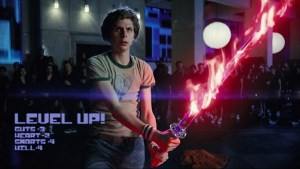
So, Scott Pilgrim is basically a romantic comedy, just one that's spent all its quarters for sanity meds on arcade tokens instead. The world of Scott Pilgrim is an 8-bit one, even though those are real people you’re watching. Based on the comic series by Bryan Lee O’Malley, Pilgrim’s world is much like our own, only it’s been run through a Nintendo cartridge a couple of times times. Scott earns points for daily activities, and even levels up at key moments. In Scott’s world, 1-ups wait for those who earn them and people can store five foot sledgehammers in a purse, Granny tweety-style. There is absolutely ZERO explanation given as to how such a world functions and, you'll either buy the bit and premise, or you won't. The film doesn’t stop for anything, and while it doesn’t take anything too seriously, the interpretive physics and wire-fighting are played straight, without ever seeming like some sort of parody.  The nonchalance everyone shows for flaming katanas and lesbian ninjas lets you know that this world doesn’t care why such things exist, so why should you? O'Malley's knack for blending fan-boy absurdity with the everyday makes for a terrific blend on film; wouldn't every bad date movie find just a little life by throwing in some pyrotechnics for no reason?

While the rules are more or less game-based, director Edgar Wright presents his adaptation as if the viewer is watching a comic book in motion. There are many, many comic book movies out there, but most are a translation of the story instead of the way it gets told. With Pilgrim, Wright has made a movie that feels like a comic book come to life. Shot changes feel like moving to another panel and each scene transition plays like a turning of the page. Most shots are accentuated with little comic book elements ranging from visual onomatopoeia, to HUDs showing vital character statistics. It’s a real treat for the eyes, one that will no doubt benefit from multiple viewings in order to soak up all the hidden Easter eggs. The whole movie is structured like a video game and as Scott’s trials increase in difficulty, so too does the insanity.

It’s not long before the fist-fights become bass battles and sword clashes, which can be a lot to handle. The escalation can lead to fatigue before even half the exes are dispatched of, and the film sags during the second act. Yet every fight brings something new and fresh to the experience, leaving the viewer excitedly waiting to see what’s in store for the next brawl. And it’s during these intense sequences that director Wright really shows his talent for filming complex action, which was hinted at by the 30-minute shootout that capped off his last film, Hot Fuzz. Wright’s always had known how to inject energy into mundane tasks (a trademark he takes time to skewer here) but hasn’t had a chance until now to go all out. Here, his highly kinetic filmmaking is applied to a property that needs a lot of energy, and the results are impressive.

Despite weighing all of 120 pounds, Scott is a 1st class ass-kicker, and Wright’s willingness to go over the top fits in perfectly with the material. Scott will be fighting more than half a dozen foes at one time but the action is never cluttered because the choreography is so well thought out. Most fights contain extensive shots where you can visibly see Cera belting out and taking shots, and you never feel like you’re just watching a stunt double. Even when a battle between the anime avatars of rock sub-genres breaks out, Wright’s measured approach to chaos makes the mayhem effortlessly watchable. As an action picture, Pilgrim is a winner because instead of trying to walk the tight-rope of plausibility, it says “to hell with it”, and instead focuses on being as crazy as possible, back flipping and roundhouse kicking all the while.

Yet, Scott Pilgrim’s success as a comic book/video game come to life means it has substantially more difficulty with an area that is a pitfall for both mediums: character. While O’Malley’s creations are endearing in print, on the big screen, they feel far more two-dimensional. There’s an uncanny valley to real people acting like cartoon characters that’s a bit jarring at first, and the only way to get over it is to realize that these aren’t people you’re watching, but instead the kind of broad archetypes you would find in a comic book. There’s a distinct lack of depth to everyone, including Scott, which makes the introspective elements of the story feel hollow. In fact, the central romance between Scott and Ramona seems incredibly dysfunctional, with Scott being inexplicably obsessed with a girl who’s consistently cold and fickle. Then there’s the treatment of Scott’s high school girlfriend, the inventively named Knives Chau (Ellen Wong). Scott thoroughly mistreats her, an addition to the film not found in the books, and the resolution to their relationship is rushed, leaving you thinking of Scott as kind of a dick.
The lack of depth in the characters will be exacerbated for some people by the film's overt "hipness." Remember, this is a film about young twenty somethings in Toronto, where seemingly everyone is in a band, and the dress code is strictly value village/Urban Outfitters. Be prepared for dialogue that’s steeped in irony and sarcasm, though it helps that its often very funny all the same. Despite its more youthful sensibilities, the complete lack of self-seriousness lets the actor’s words come off as light-hearted and goofy as opposed to obnoxious. A lot of that is due to the fact that the massive ensemble cast is excellent all the way through. Between its two leads, seven villains and a dozen other supporting characters, Pilgrim is bursting with charming and memorable performances that stay true to the source material, which is especially impressive since some characters are on screen for less than five minutes. Stand outs from the supporting cast include Anna Kendrick as Scott’s know-it-all sister, and Kieran Culkin as Scott’s exuberantly gay and equally hilarious roommate. Mary Elizabeth Winstead is perfectly mysterious as Ramona, which makes it a shame she doesn’t have more to do here. But the real star is Cera as Pilgrim, and if anything is going to convince people that he has a future as an actor, this is it. Breaking out of his more nebbish roles, Cera is playing the hero here, one you mostly want to root for, despite his shortcomings. About the highest compliment I can give him is that at no point did a think I was watching Michael Cera, which is a pretty damn big step forward.

There’s really no other movie out there quite like Scott Pilgrim vs. the World. While it may fall short as a love story of fully realized characters, the film manages to create a world of such imagination and energy that it’s almost impossible not to get swept up in it. Staying true to its niche spirit, the movie never settles for broad appeal and knows what it wants to be: a tribute to the wonderfully weird worlds of video games and comic books.

4 out of 5

Directed by Edgar Wright

2010, USA

In Reviews, Yeah! (4 out of 5) Tags Allison Pill, Brandon Routh, Bryan Lee O'Malley, Chris Evans, Edgar Wright, Ellen Wong, Hot Fuzz, Jason Schwartzman, Kieran Culkin, Mary Elizabeth Winstead, Michael Cera, Scott Pilgrim Vs- The World, Scott Pilgrim Vs- The World review
Comment
4220xtylnking.jpeg

Review: The King's Speech

September 26, 2012

Originally Posted December 28th, 2010

Albert Frederick Arthur George did not have an easy life growing up. He was plagued with health issues and was constantly tormented by his older brother Edward. His father, who left him in the care of various nannies, expected greatness from him, even though Albert's older brother was likely to inherit the family legacy. Although meek as a boy, Albert eventually began a career in the navy, seeing limited action during the First World War due in part to his poor health. He would eventually attain the rank of Commander in the Royal Navy shortly after the untimely death of his youngest brother John at the age of 13. In 1920 he met Elizabeth Bowes-Lyon, the woman who would become his future wife and the mother of his two children, Elizabeth and Margaret. Albert entered into the latter half of his life as a representative of his father's estate, seemingly content with where his life had taken him. But then something unexpected happened. Only a year after the death of his father in 1936, Edward made the unprecedented act of resigning as head of the family estate in order to marry, leaving Albert in charge. Of a kingdom. The United Kingdom.

The King's Speech premiered at the Telluride Film Festival in early September of this year to rave reviews. It would win the People's Choice Award at the Toronto Film Festival and I was not pleased. 2010 was the year that delved deeper into dreams than ever before, explored the too-good-to-be-true origins of the internet's first billionaires and gave us a raw detective mystery set in the meth-addled Ozarks. The last thing I wanted was another fucking period piece about the British royalty to come in and win over critics the way so many others have in recent memory. The fascination that Western society has with the monarchy is odd to say the least and why the Queen adorns most of the contents of my wallet is an entirely different conversation. But look at any news rag and you’re sure to find at least one massive spread about Prince Williams engagement announced more than a month ago. Film critics in particular seem infatuated with royalty, just look at the scads and scads of awards picked up by films like Elizabethand The Queen. I've always felt that the gravitas of these pieces often outweigh their merits as a narrative, falling back on the work of the actors (and often costume design) more than the actual plot. Hell Judi Dench, a tremendously skilled actress in her own right, managed to pick up a best supporting actress Oscar for playing Queen Elizabeth I for 8 minutes.

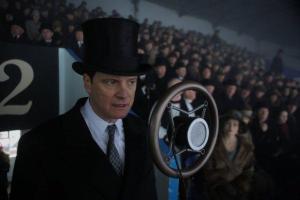
So it is with great joy that I tell you that The King's Speech is in many ways the antithesis of your average regal biography. As the Duke of York, Albert shows qualities hardly befitting of a king; he's short tempered and is easily cowed by both his brother and his father. It's easy to be caught off guard when he spends a solid minute purposefully reciting every expletive he can think of, because it's, well, funny. Humour is often in deathly short supply in historically accurate period pieces and especially when people of such standing are involved. But the film is more interested in George's journey to becoming a king then his action's as one and it's that journey that's simultaneously charming and soul stirring. The film shatters the veil surrounding the monarchy and shows them as regular people asked to become extraordinary ones, a task which not everyone is given equal chance. Among Albert's many personal defects, he developed a terrible stammer at a young age, leaving him a largely ineffectual public speaker. The film opens with a disastrous address at Wembley stadium, a scene that recalls director Tom Hooper's The Damned Untied, another film about a leader, in his case football manager Brian Clough, who must face down personal flaws before attaining true greatness. Albert's inability to address the people is compounded by the advent of radio and recording devices, and the prospect of a king who can't address his people largely spurs Albert's wife Lady Elizabeth to seek a speech therapist.

Geoffrey Rush plays Lionel Logue, an unconventional speech therapist who, unlike Albert, has dreams of being a monarch, although his are confined to the stage. Logue, though initially struck that his meeting with misses Johnson is actually with the future Queen of England, sets out to treat Albert, but only under the condition that he be treated as a person, not as a prince. The relationship between Albert and Lionel, one royalty, the other the son of a brewer, is where much of the film's humour comes from and it's delightful to see Rush's playful performance bounce off of Firth's initially reserved personality. With much of the film portraying the two’s various speaking sessions, The King’s Speech could have been easily mired in static back and forth but Hooper knows how to highlight the centre of attention in a conversation, particularly, Firth's struggle to simply uphold his end of it. Logue's unorthodox training methods lend themselves well to some very creative montages and moments of small triumph and failure highlighted by pronounced camera movements. The film is at times sluggish in its development of the pair's relationship and much of the more biting humour is reserved for the first half but as Logue's treatment begins to become more psychological than linguistic, the gravity of Albert's situation becomes more and more apparent. As a king, he has no real power beyond representing the voice of his people and with the rise of Nazi Germany, the need for a leader who can rally his people increasingly dire.

I hope you don't think me a hypocrite to say that the film largely stands out for its sublime performances. Firth range covers a wide breadth, and it’s made all the more remarkable by his constantly changing speech patterns. Joke all you will about handicaps as Oscar bait, this is a case where the “gimmick” actually punctuates the skills of the actor, as Firth shows Albert as both a man unprepared to handle his legacy and a king ready to lead his people, one frustrating word at a time. In particular, the scene in which Albert reveals his harsh upbringing to the commoner who's gone from his secret therapist to his only friend showcases the work that garnered Firth a nomination last year and almost certainly a statue this year. Rush plays Logue with enough energy to inject just a hint of whimsy into the film but never at the expense of the otherwise sombre tone. Finally, Helena Bonham Carter shines as Lady Elizabeth, a woman who has been learning what it means to be royalty since she married Albert. Carter’s been doing great work for years now and she’s as brilliant here as her role is brief.

Historical pieces often have a bad habit of overstaying their welcome so the fact that The King’s Speech left me wanting more is something I altogether didn’t expect. It’s easy to lump crowd-pleasing films together because it’s often the way a film ends that sticks out, but here’s one crowd pleaser that dares to show a different side to figures we ultimately don’t know all that well. In the titular speech King George gives at the outbreak of WWII, he says he wishes to address his people as though he were in their homes and this was indeed the first step towards the modern monarchy. We know more about our royalty’s personal lives than any previous generation, and for better or worse, technology, like this film, has revealed them as who they are; people who must weigh the greatest of privilege with the greatest of expectations. But still just people.

5 out of 5

Directed by Tom Hooper

2010, U.K., U.S.A

In F*ck Yeah! (5 out of 5), Reviews Tags Colin Firth, Elizabeth, Geoffrey Rush, Guy Pierce, Helena Bonham Carter, Judi Dench, The Damned United, The King's Speech, The King's Speech review, The Queen, Tom Hooper
Comment
mercenarios_33.jpeg

Review: The Expendables

September 25, 2012

Originally Posted August 25th, 2010 

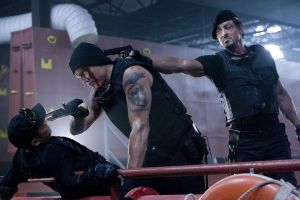
Come on. We all knew this was how it was going to turn out. No matter how badly we wanted to believe they could do it, too much time has passed. When we all heard that Sylvester Stallone was going to unite the biggest action heroes of the last thirty years under one blood-soaked banner, the internet's collective jubilation was laced with a deep-seated fear that this would be an impossible feat to pull off. In trying to recapture the spirit of the 80’s action flick, The Expendables plays more like a relic, just with modern trimmings. Its aging stars and uninspired script, which must have been about twenty pages if one-liners were excluded, make you wonder if this was a genre that should have just stayed put in the more reptilian crevices of your memory. Even when trying to deliver the gratuitous explosions and gunfire that made the likes of First Blood and Commando genre classics, The Expendables can’t get a grip on the advances of special effects, and sacrifices authenticity for the sake of one-upmanship.

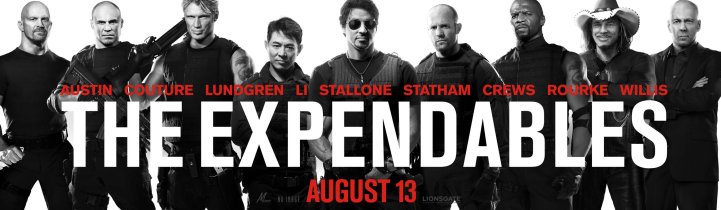
After a ponderously slow first few minutes, we meet the titular group of manly-men mercenaries, including Jet Li, Dolph Lundgren, Terry Crews, Randy “The Natural” Couture and the leader of the outfit, writer/director Sylvester Stone. The foreplay is brief, as it's mere moments after the introductions that a pirate is literally blown in half by a shotgun blast. You might say the dismemberment and copious CG blood are holdovers from Stone’s last directorial outing, Rambo, as it’s a good barometer for what the next hundred or so minutes are going to be like.

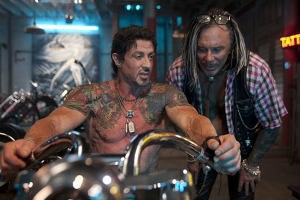
After successfully returning to their tattoo parlour/bar/all-around-man-cave run by Mickey Rourke, Sly accepts a suicide mission from a CIA handler played with deadly seriousness by Bruce Willis, in an overly advertised and far too brief scene featuring Stallone, Willis and Arnold Schwarzenegger in the same room. It’s hard not to bro-out a little during the scene, as Schwarzenegger’s entrance is punctuated by an inexplicable divine light, while the winks and nods between the three great apes are telegraphed with the finesse of a bat to the face.

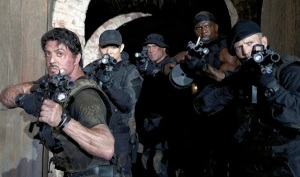
Being the good soldier of fortune that he is, Barney signs up the crew to take down a military dictator in the sinisterly named island nation of Vilena, where there’s some scheme involving coke fields, an ex-CIA spook and Steve Austin. There are betrayals, unrequited loves and perfunctory speeches about the soulless life of a mercenary, none of which are handled with much subtlety, but subtlety isn’t what this movies about now is it? It’s about shit blowing up, bones being busted, SMASH-BAM-POW-GAAAR. Which isn’t so much The Expendables's only redeeming trait as it is pretty much its only trait period.

This is an action movie from start to finish, so it won’t confuse anyone who accidentally walked in thinking this was Eat Pray Love. To his credit, Stallone knows how to stage shoot-outs and fist-fights, and boy are there plenty. The number of baddies disposed of by Stallone’s motley crew borders on genocidal, and it’s a rare feat that an action scene can be so skilfully chaotic that a man’s head literally blowing up isn’t the centre of attention. The action is by no means flawless, as all the gunfire and exploding can be desensitizing by the time the film reaches its bombastic final twenty minutes, and a pair of car chases in the film’s first half may be some of the worst filmed in recent memory.

What really holds back blood-n-guts orgy are the attempts made to use newer special effects to beef up the skirmishes, the apparent aim being to make every other action movie obsolete. It was probably because of Rambo that Stallone decided you could get more blood for less by adding it in during post-processing. And hey, while we’re at it, why not get rid of the rigidity inherent in actual explosions and just code it for cheap? It’s understandable really, audiences just aren’t wowed by violence the way they once were and the solution is always just to add more and more. But in doing so, The Expendables betrays the very films it seeks to honour. Sure John McClane only blows away about a dozen dudes in Die Hard, but it looked real. When the roof of the Nakatomi Plaza blew up, you were watching a giant explosion consume a building and it felt real. With TheExpendables, the sheer overload of the set pieces combined with the CG effects, which range from passable to laughable, dissolves what little sense of reality the film wants to maintain.

This wouldn’t be quite so frustrating if the movie were good at anything besides action, but Stallone’s words don’t flow nearly as well as his fists. When your characters are a biker gang of Neanderthals, there’s no real room for character development, and attempts at being reflective about the whole killing business feel shoehorned in. The greater shame is that the film’s many, many one-liners, a staple of the genre, are almost entirely forgettable, and it doesn’t help that between various accents and Stallone’s growling that much of the line delivery can be tough to interpret. But again, brilliant writing isn’t one of the things The Expendables is aiming to achieve and it looks to supplement words with casting. Despite his noticeably aged face, Stallone’s giant everythings ensure he’s who you imagine leading a suicide squad of mercs, and Statham brings his trademark frame and charm to what few scenes he’s in that require actual acting. It’s a hell of a crew Stallone’s assembled, almost to a fault. Crews is under-utilized and it’s easy to forget that Couture is even in this movie, although he does once and for all finish the debate between the UFC and WWE fans.

Be wary of advertisements claiming that this will be the first and only time we’re going to see such a macho medley of beefheads join forces, as receipts have been strong and the film’s ending presents future jobs for The Expendables as a certainty (which also enforces how much of a misnomer their title is). But what could have been a testosterone fuelled tribute to filmmaking of years past turned out to be a retread that simply drags out a genre and cast that’s just not as youthful as it once was. You got me this time Stallone, but by invoking the hallowed images of your past works and actors like you, you set yourself up to sit in the shadows of the classics that defined the action movie. And no amount of CG blood can cover that up.

2 out of 5

Directed by Sylvester Stallone

2010, USA

In *Yawn* (2 out of 5), Reviews Tags Arnold Schwarzenegger, Bruce Willis, Die Hard, Dolph Lundgren, Eat Pray Love, Jason Statham, Jet Li, Mickey Rourke, Rambo, Randy Cotoure, Steve Austin, Sylvester Stallone, Terry Crews, The Expendables, The Expendables review
Comment
extra-the-kids-are-alrigh-001.jpeg

Review: The Kids Are All Right

September 24, 2012

Originally Posted August 17th, 2010

Arriving just in time to send the summer off in style, the year’s biggest art-house flick not involving Swedish goth hackers is The Kids Are All Right. The film, about the mounting struggles two women in a domestic partnership face when the biological father of their children reenters their lives, is both familiar in set-up, yet fresh in how it approaches the usual tropes of a modern family drama, with a maturity that’s both thoughtful, and warming.

Without preaching, The Kids Are All Right, manages to draw a well-realized portrait of a self-described “unconventional” family that deals with the same issues a thousand straight families have dealt with in other movies. Themes of love, growing up and sexual identity are all addressed here, and the film has nothing terribly new to add to the discussion of child rearing, just that a same-sex household faces the same hurdles as any other marriage. The film’s near ambivalence as to which sex combination makes up a family lets it stay more focussed on being one of the most sophisticated and delightful films of the summer.

Annette Bening and Julianne Moore star as Nic and Jules, a lesbian couple raising two teenagers in the wine-soaked hills of present-day California. Like many others living in relative luxury, their daily life is filled with quarrels about minor things, mostly involving their kids, but their's is a relationship that’s built on a solid foundation of trust, the likes of which is formed only after spending many years with another person.  Nic’s perfectionism as the main breadwinner of the household can put her at odds with Jules’ more lenient approach to things, but their little spats dissolve almost effortlessly.

The strength of their relationship with one another seemingly carries over to their children, in parent-child dynamics that ares open and communicative, which alone is uncommon for most pictures dealing with parenting at middle age. There’s a moment where, after giving her rendition of a Joni Mitchell tune at the dinner table, son Laser jokingly tells Nic not to quit her day job, before returning with a compliment. It’s little moments like this where the kids channel the mostly tolerable embarrassment of living with your parents when you’re almost an adult, and they do so without ever resorting to the levels of overwrought angst and drama that commonly define onscreen teens.

Their daughter's final summer at home is interrupted when Laser, wanting to learn more about their biological father, gets in contact with the sperm donor that was used to conceive the half-brother and sister. The donor, Paul, played with relaxed aplomb by Mark Ruffalo, takes a shining to his two offspring, and quickly becomes increasingly involved in their lives, as well as those of Nic and Jules. Paul, an organic farmer and restaurant owner, while laid-back and maybe a little dim, is basically a nice guy who’s finally beginning to see what he’s missed out on by leading the bohemian life of the handsome bachelor, and the film respects him enough to create a character instead of just a roguish wedge used to drive a family apart. He inevitably does, of course, as everyone but Nic seems incapable of getting past his free-spirited charm, but again, the film is far too mature to let a single person be responsible for all the developing cracks in the household. Rather, The Kids Are All Right, serves as a lesson on how all the unspoken crap a family accumulates through the years can boil over when a new element is added to the status quo.

What’s most admirable about director Lisa Cholodenko’s picture is how little of the picture is centred on the idea that it’s one single issue that leads to this families eventual breakdown. The fact that the central relationship in the film is a homosexual is never given much mind by the characters, and any opinions on the idea of a same-sex family are left to the viewer alone. Having two mothers for parents is played for laughs where appropriate, mostly in bringing Paul up to speed on the situation, but it’s for the most part regarded as inconsequential, as you’ll quickly get used to Joni and Laser referring to their mothers in the plural. Similarly, having one kid born from each mother sets up an obvious dynamic of child against child as a proxy comparison of the mothers. Again, The Kids Are All Right doesn't take the simple route, and has far more much fun in showing how family members can be eerily similar, even if genetically unrelated . The main plot points of the film, such as the appearance of Paul and the looming end of Joni’s life at home, are seen as not the real issue here, they’re merely events that continue to chip at the foundations of one family's normal.

In broadening its scope beyond a single salient issue, The Kids Are All Right encounters its only real difficulty by adhering to the usual elements of the family drama, and beyond the premise, there’s not a whole lot about it that's groundbreaking. Affairs are had, tears are shed, and everything eventually gets more or less resolved by one big speech (granted, it’s a good one), which is a synopsis fitting of a hundred other pictures. While the film smartly refuses to exploit its premise for the sake of novelty, it makes this unconventional group's story feel surprisingly familiar, albeit one that’s better realized than most. Cholodenko’s dialogue is written for real people, youthful and realistic without straining to sound hip, and the script goes for modest, consistent laughs as opposed to great big gags that cash-in on setup. The acting is top-notch, most notably from the two leads, as Jules' strikingly poignant moments of self-reflection are countered with Nic’s social boozing, including a particularly funny tirade about California's progressive environmentalism. The state itself is gorgeously captured across expansive vistas and lavish meals, but the quality of the dialogue and acting are what give the film its own distinct flavour.

Much like the bottles of wine prominently displayed in the film, The Kids Are All Right is at first glance, a known quantity, featuring the usual bullet points found in most family dramas, seemingly distinguished only by a twist on the common premise. But thanks to Cholodenko’s charming characters and smart script, the rest goes down smoothly. The perfect summer film for the thinking person, The Kids is more than alright.

4 out of 5

Directed by Lisa Cholodenko

2010, USA

In Reviews, Yeah! (4 out of 5) Tags Annette Bening, Josh Hutcherson, Julian Moore, Lisa Cholodenko, Mark Ruffalo, Mia Wasikowska, The Kids Are All Right, The Kids Are All Right review
Comment
recount_2008_576x291_562607.jpeg

Review: Recount

September 23, 2012

Originally Posted July 20th, 2010 

When major decisions are determined by thin margins, it’s easy to ask oneself, “What if…?” Take, for example, the presidential election of The United States in 2000, a race that was, at one time, separated by less than two hundred votes. What if the machines in Volusia County hadn’t gone haywire and altered the voter tallies? What if the ballots hadn’t been double sided and so hard to punch? What if there had been a film that explained what was going on in a way that even a political dunce like myself could understand? After watching Recount, I have an answer for the last question, but more importantly, those first two questions become uncomfortable, even dispiriting, to consider.

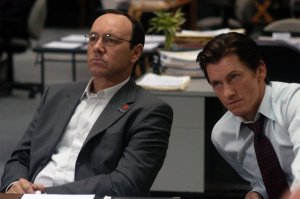
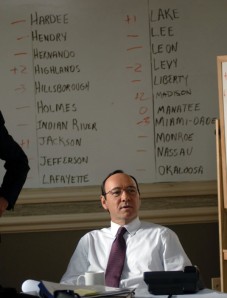
Recount has a tricky line to walk - it needs to recreate the events of the Florida recount in a manner that's entertaining, but also truthful. Based on extensive research and countless interviews with nearly all the key figures, Jay Roach’s film plants the viewer right in the heart of both the Republican and Democratic campaigns, as each party tries to wrest the outcome of the election away from the other. Centring the film is Kevin Spacey as Ron Klain, the Gore campaign's prodigal son, whose shot at political restoration fuels his no holds barred approach to getting the votes counted. Spacey is backed by a bevy of other seasoned actors who, in addition to being universally convincing, also look eerily similar to their real life counterparts.

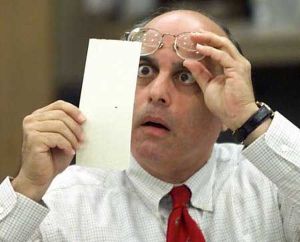
Scenes hastily jump back and forth between party camps as they respond to rulings and polls, with each group trying to outmanoeuvre the other. By showing the reactions on both sides, Recount is able to clearly communicate to the viewer the importance, if not always the details, of the day's battle. Easily the greatest strength of the film is how it manages to make mounds of political jargon and legal proceedings not only understandable, but exciting. Numerous court rulings concerning the validity of a dimpled chad (voting bubble) have the weight of a referee decision in overtime. There are so many small victories for each side that every ruling and arbitration feels like a another sway in the direction of an all-out war for the White House.

While the film wants to be taken seriously as a factual re-enactment, much of Recount’s impact comes from how well it dramatizes seemingly inconsequential events. When indication is first given that something is wrong with the voting machines, there’s a frantic race to stop Gore from giving his concession speech. It’s all heightened for dramatic purposes, but it’s certainly entertaining. Similarly heart-pounding is the appearance of a mob at one of the recount centres, where Bush supporters assault a Gore lawyer carrying a sample ballot. Again, it’s engaging because such confrontations actually happened. But as the adaptation elements begin to overtake the documentary ones, it becomes clear that anyone looking for a neutral appraisal should look elsewhere.

Recount’s only real failure is that in taking a dramatic look at the California recount, it loses its chance at being a balanced take on the events. It can be hard to blame the film though, because in reality the Democrats were, from the get-go, in a more sympathetic position. While the Gore campaign was broadcasting the idealistic motto of “every vote counts”, the Republicans had to respond by stopping the counting of invalid votes, even though they had by all accounts won. Just about every court and legislative body concerned with the recount at that time was either Republican, or somehow associated with Bush. Again, these are facts that simply enhance the perception that Gore is somehow fighting uphill against impossible odds. The Democrats come off as the scrappy underdogs while the Republicans can’t escape the appearance of having tried to not so stealthily pull the wool over the public’s eyes. Though the film can be forgiven for any opinion generated by the circumstances of the recount, certain dramatic elements only serve to reinforce the feeling that the creators are coming at the material with a strong opinion of their own.

By anchoring the story around the Gore campaign’s leader, any semblance of impartiality goes out the window. There’s some backstory given about Klain and Gore’s uneasy partnership in the past, but that history serves only to make the audience sympathetic with Klain’s attempts to redeem himself. There’s no one to humanize the Republican side the way Klain does for the Democrats. While the film makes a point of indicating that Klain was more interested in the votes being counted than the actual winner, he’s still the nice guy trying to make good, and you want him to succeed. The only person on the Republican bench given adequate screen time is Laura Dern as then Florida Secretary of State Katherine Harris, who comes across as more of a preening debutant than an elected official.

It’s the subtleties of how the Republican Party is treated that are more concerning. Every action by a Bush supporter feels much more cloak and dagger than anything done by the liberals, and there’s an air of subterfuge about every closed door meeting and late night rendezvous. Even the Bush campaign camp, led by a Dr. Pepper chugging Tom Wilkinson, feels more based on caricatures, thanks to an almost entirely white, crew-cut sporting army of lawyers. The Bush camp contrasts heavily with the more ethnically diverse Gore crew, which operates more like a team. It’s often hard to tell where the re-enactment part of the film ends and the dramatic elements begin. It’s not the fault of the creators that they have an opinion, it just feels like any approach that isn’t apolitical is a betrayal of the authenticity that the film flirts with.

HBO was smart to approach Recount as a made for TV-movie as opposed to a big screen release. The election of Barrack Obama was mere months away, and it seems doubtful that people would pay to watch a movie about the difficulties of simply casting a vote. It’s a reminder of a period many have forgotten, but for others, would reopen the old wounds of a power transfer that looked less like an election and more like a barbaric tug-of-war. Yet, Recount’s timely release is all the more important because even though its politics aren't so subtle, it's good to know that, yes, every vote matters.

4 out of 5

Directed by Jay Roach

2008, USA

In Reviews, Yeah! (4 out of 5) Tags Denis Leary, HBO, Jay Roach, Kevin Spacey, Laura Dern, Recount, Recount review, Tom Wilkinson
Comment
the-losers-new-poster.jpeg

Review: The Losers

September 22, 2012

Originally Posted July 23rd, 2010 

In 2010, a crack commando unit was accused of a crime they didn’t commit. Hunted by law enforcement, they promptly escaped to the underground. Today, still wanted by the government, they survive as soldiers of fortune. If you have a problem, if no one else can help, and if you can find them, maybe you can hire… The Losers!

Wait, that’s not right. That’s the set-up for the new A-Team movie. Stupid mistake. The A-Team was about an Army Ranger unit that was framed for a crime they didn't commit and had to seek out justice as fugitives from the law.The Losers is about a CIA Special Forces unit that gets framed for a crime they didn’t commit and has to get revenge while fugitives from the… huh. Well what about a van, do The Losers ever drive around in a van? …They do…Well what about an ending gun fight in a downtown harbour, I bet The Losers doesn’t have that! They do?…okay, now this is just spooky.

With The A-Team getting released barely two months after The Losers, comparisons of a Deep Impact-Armageddon variety seemed inevitable. Despite more than fifteen years separating each's source material, the set-up for both films is more or less identical, just with one elite army agency swapped out for another. Both films are sold as being flashy, brainless action romps with quasi-militaristic overtones. They both also feature cartoonishly evil bad guys, and a single female character whose sole job is to provide sexual tension. All these similarities are plenty evident, yet little mention was given when The A-Team rolled into town. That’s probably because The Losers, based on the Vertigo comic series of the same name, isn’t a particularly memorable film; it combines mediocre thrills with a mercifully short running time into a movie you’ll likely forget existed at all, let alone as a piece of parallel programming.

Starting out in the Bolivian jungle, The Losers wastes no time in acquainting you with the titular group of rough-and-tumbles. There’s the leader Clay, played by Jeffrey Dean Morgan (whose charisma is mostly owed to his tailor), the grizzled weapons man Roque, played with unflinching seriousness by an utterly wasted Idris Elba, and a surprisingly enjoyable Chris Evans, who gets plenty goofy as the techie Jensen. There’s also sniper/cowboy hat aficionado Cougar (Óscar Jaenada) and wheel man Pooch (Columbus Short). From the opening poker-game played with weapons instead of chips, it’s clear that no one could decide which character would get the title of “The Badass,” so they went ahead and gave it to everyone. After a bombing run on a drug lord is thrown off by the presence of a literal busload of children, the team, in gallant disregard for orders, intervenes, and winds up getting themselves framed by a mysterious villain known as Max. Just a tip for future reference: if mention is ever given of a change as to who’s going on the last helicopter out of dodge, get as far away from that chopper as is humanly possible. It’s not long before the gang is given means to exact their revenge thanks to the alluring Aisha (Zoe Saldana), who, despite having less meat on her than a starved gazelle, can break bones and chairs with the best of them.

That’s about all the set-up you’re going to get because once The Losers leaves the driveway, it doesn’t stop for anything. What follows is your typical checklist of action movie set pieces across some of the brightest, sweatiest places this side of the Atlantic. The amount of lens flare in some scenes made me feel physically tanner. There are flashes of excitement in most of the action sequences, but they're nothing wholly original. The meet/beat-cute between Clay and Aisha is pretty much right out of Mr. and Mrs. Smith, and is mostly enjoyable because of Zoe Saldana’s complete disregard for the safety and well-being of all pieces of furniture within her five foot radius. And for as built-up as some of the action sequences get, you’re usually just left wondering, "is that it"? If a movie's main selling point is leaving physics and rationality at the door, you need full-blown commitment to lunacy, and The Losers just feels like a series of half-measures. It’s unfortunate, but airlifting an armoured car with a magnet attached to a helicopter just isn't enough these days. Here all you get are a couple of pretty good explosions sandwiched between timid gun fights and some really unconvincing CG effects.

Then again, what aspects do go for broke still find a way to make The Losers a sub-optimal viewing experience. Breaking up the shootier bits are interludes where we check in on our villain, who seems incapable of elaborating on the next phase of his diabolical plan until he’s in a new time zone. This is where any energy that gets generated by the aforementioned shooting runs into the brick wall that is Jason Patric’s performance as Max. Now, The Losers is by no means a serious film, and everybody is clearly having fun with their parts, but Jason Patric wants you to know that he is having more fun than anyone, ever, ever. With a level of restraint that makes Jack Nicholson’s Joker look docile, Patric goes out of his way in every scene to try and be menacing, but it almost always comes off as buffoonish or just plain ridiculous. After reminding his head goon how badly he needs eighteen gunmen in twelve hours, you think that there’s no possible reason that he’d repeat himself it a third time; and then he does. And then in the next scene, he orders those gunmen to be killed. Why? Because he’s evil, that’s why! At one point he responds to a bullet in his shoulder not with, you know, signs of pain, but with a level of mild annoyance reserved for when someone hits you with a rubber band. Oh, and then he sticks his finger in the wound and has a taste of his own blood, which, I imagine tastes pretty good thanks to the Cost-co sized cans of energy drinks he must have been downing between scenes.

As certifiably insane as Patric is, he’s about the only thing that’s aggressively bad about The Losers. Sure there are a myriad of gapping plot holes and unexplained motivations but this is a movie about characters and action, not story. To their credit, everyone else in the cast is competent enough and it can be occasionally fun to revel in their brainless exploits. Chris Evans is the real standout, as he manages to make the most out of every scene thanks to a mix of crass humour and brazen self-awareness. His natural response to the absurdity of bringing a crossbow to a gunfight is simply to declare “that’s right bitches, I’ve got a crossbow.”

The screenplay, written by Zodiac scribe James Vanderbilt, is drenched in these sorts of immature one-liners and really the only word I can think of to properly describe The Losers is juvenile. Every yo momma and dick joke seems perfect for the PG-13 audience the film no doubt hoped would flood cinemas but didn’t. I mean for god sakes, the bad guy’s weapon of choice is called a SNUKE. Even the film’s romantic subplot, which consists of Zoe Saldana showing up with a bottle of tequila followed by immediate boning, is designed to target barely pubescent thirteen year-olds. Which pretty much sums up The Losers; it’s all action, no foreplay and completely forgettable.

2 out of 5

2009 USA

Directed by Sylvain White

In *Yawn* (2 out of 5), Reviews Tags Armageddon, Óscar Jaenada, Chris Evans, Columbus Short, Dean Morgon, Deep Impact, Idris Elba, Jack Nicholson, James Vanderbilt, Jason Patric, Mr- and Mrs- Smith, Sylvain White, The A-Team, The Losers, The Losers review, Zodiac, Zoe Saldana
Comment
batman-watching-over-the-city.jpeg

Six Ideas for Batman's Movie Future

September 21, 2012

Originally Posted to Playeraffinity.com, August 25th, 2012

As it's been pointed out for the better part of a month now, there's plenty to admire (or more bluntly, slavishly fawn over) about Christopher Nolan's The Dark Knight Trilogy. He not only proved that people will pay a ton of money to see summer movies that are more emotionally and intellectually stimulating than $250-million dollar versions of Rock 'em Sock 'em robots, but also showed that a reboot can be a reinvention instead of just a rehash. And perhaps best of all about The Dark Knight Rises, is that it brings his Batman trilogy to a definitive end, granting audiences closure as he and Christian Bale ride off into the sunset with no intention of even returning to Gotham...

...which is probably why some Warner Bros. exec is currently pulling his or her hair out trying to decide what to do next, since Nolan has burned down the franchise torch so close to the handle, whoever he passes it on to next is going to get burned. Where can Warner possibly go after the unparalleled success of The Dark Knight Trilogy? Is it time to hit the reset button and start from scratch, or see where the few threads left dangling may lead?

Here are a few different thoughts and angles to consider now that the prospect of making a great new Batman movie seems even more daunting than after the boondoggle that was Batman & Robin. First, let's explore the many possibilities of rebooting the Caped Crusader, then discuss the options for a slightly more direct sequel to the trilogy. And if you're one of the three people who hasn't seen "Rises" yet, prepare to have it spoiled.

The Reboot Route

Distance Yourself From The Nolan Films As Much As Possible: 

One of the biggest problems with Marc Webb's recent superhero reboot, The AmazingSpider-Man, is that it's aesthetically indistinguishable from Sam Raimi's original trilogy, and offers only slight changes in tone and characters to get us through the same origin story we've already seen. Having to watch two Batman origin movies in the same decade would suck, as would trying to make a reboot in the vein of The Dark Knight Trilogy. Whoever winds up following Nolan will inevitably be ill-equipped to recapture his kinetic, more realistic take on Batman, so no one should even try.

The best course of action will be to either take an approach that's either much lighter, or even darker. As for setting up the character, any reboot would be wise to alter the traditional story heavily, or skip over it altogether. Whoever doesn't know that Bruce Wayne's parents got shot when he was young, and that he has a thing for bats, probably doesn't care about Batman in the first place.

Follow Marvel's Lead: Fun First, Brand Building Second

Sure, a lot of The Dark Knight Rises' success at the box office is due to it offering a darker, more mature alternative to Marvel's breezy and more gratifying superhero flicks, but Batman's been goofy a heck of a lot longer than he's been moody. A return to Batman's campier, but more accessible roots would help give a new film its own identity, while also giving DC the opportunity to build towards something they've wanted for years: a "Justice League" movie.

Marvel launched the "Avengers" initiative with Iron Man because he's the most relatable and charismatic character in their roster; the same could be said of Batman for The Justice League. While next summer's Man of Steel is rumored to get the team-up ball rolling, early teasers make it appear nearly as grounded and serious as Batman Begins was, and the whole point of crossovers is that they're meant to be fun and exciting, something The Avengers did really well.

To wit, i'm going to say three words no one wants to hear: bring back Robin. It's really easy to hate The Boy Wonder, even Christian Bale said he wouldn't do a Batman movie if Robin was in it, but Batman having a sidekick makes him part of a team, which is what The Justice League is all about. A young companion helps to lighten the tone, and means Bruce Wayne's past doesn't have to be the main through line all over again.

Make The Darker Knight

It's hard to imagine a PG-13 rated superhero movie that's somehow bleaker than one in which love interests tend to die horribly and the hero's hometown does a six month LARP of Berlin circa 1945, but Batman's source material has some seriously grim alternate versions to draw from.

Take, for instance, Batman: Earth One, the newest comic to modernize Bruce Wayne's originsby reimagining the death of Martha and Thomas Wayne as political assassinations, and Gotham's police force as completely at the mercy of organized crime. Best change: prim and proper butler Alfred gets turned into a gun-toting S.A.S. badass, who trains Bruce in crime fighting, even though he should probably be the one out on the streets cracking skulls in the first place.

Or Warner could revive their original plans for the post-Schumacher era and use Darren Aronofsky's plan for a "Batman" that's part Se7en, part Dirty Harry. Instead of inheriting the Wayne estate, Bruce becomes a street rat under the care of an auto repairman named Big Al. For high-tech weaponry, Bruce has cobbled together junk, including an armoured Lincoln Continental straight out of Mad Max. While he slowly develops a secret identity that includes a hockey mask, Jim Gordon is a suicidal Serpico figure looking to violently end corruption in Gotham, and Selina Kyle is busy running a local cathouse. The latter option in particular would need something stronger than a PG-13, but a bump up in age rating is about the only way you'll out-dour Nolan.

The Sequel Route

Blake-man Begins

By conventional standards, the end of The Dark Knight Rises is about as sequel-ripe as you can get. With some instructions left by the presumed dead Bruce Wayne, hero cop John Blake finds the Batcave, and one can imagine Bruce also left a bunch of details on how to access all the hideout's special toys, and what day garbage is. Granted, it's unlikely that Blake is as well versed in martial arts as Bruce, but he's as determined to bring justice to Gotham as the original Batman, due process and civil rights be damned!

This leaves open a few options for Blake as the new protector of Gotham. John Blake does sound suspiciously like Tim Drake, a former Robin who started hanging out with the big boys once he ditched the red and green tights to form his own secret identity, Night Wing. Keeping on the name train, the reveal that Blake's full name includes "Robin" in it could mean that's the new identity in store for young John, although most superheroes will recommend coming up with an alias that doesn't actually contain parts of your real identity.

The obvious direction would be to have Blake go for the brass ring and become the next Batman. It'd be a clever way of acknowledging that the title can pass not just from actors, but from characters too. Plus, they could follow Grant Morrison's recent run of Batman & Robin comics where a (temporarily) dead Bruce Wayne is replaced under the cape and cowl by former Robin, Dick Grayson. The Robin shaped hole in the dynamic duo was then filled by Damian Wayne. Who's Damian you ask? Well to answer that, we should consider …

Talia Is Alive and Preggers

Here's what we know about Talia al Ghul: she's got serious ninja skills courtesy her father, Ra's, she and Bruce had an impromptu foyer fling (and considering Bruce's celibate streak, chances are the bat-condoms in his wallet were expired), and her death was about as convincing as Katie Holmes playing a district attorney. Unless we see a funeral, closing your eyes and slumping over doesn't cut it. During the climax of the movie, when everyone was busy watching Bruce re-enact his favorite scene from The Avengers, Talia could have easily slinked away somewhere safe to later discover she's going to have a Bat baby.

In the comics, Damian Wayne was the son Talia and Bruce, raised by the former to be about as nice as anyone could expect from a kid named Damian. But after some fast-tracked daddy issue resolution (i.e. Bruce dying), Damian settled down and became an official part of the Bat family, filling in Dick Grayson's shoes as Robin just as Grayson was filling in Batman's.

Imagine this then: Talia's shame at failing to fulfill Ra's plans for Gotham forces her into hiding, where she raises and trains Damian, preparing him for his legacy as the heir to both the League of Shadows, and Wayne Enterprises. With Bruce too busy completing his bucket list of countries to bone Catwoman in, a young Damian comes to Gotham to find the mysterious Batman his mother has told him so much about. When he finds John Blake instead of dear old dad, a more experienced, wiser John Blake takes Damian on as his ward, training a replacement that, like Bruce, has some serious family issues. It not only sets up a fresh story dynamic, but also seeds possibilities for more sequels, by having a future Batman waiting in the wings.

Take Batman Global

Speaking of Grant Morrison, before DC comics decided their continuity had become as tangled as Christmas lights caught in an airplane propeller and hit the ol' reset button on everything, Morrison started a "Batman" series that saw Bruce Wayne taking his fight against crime around the world. Batman Inc. had Gotham's guardian branch out across the globe, finding promising crime fighters to enlist as Wayne-funded protectors for their respective regions.

While Gotham has been the most important uncredited character in Nolan's films, it's taken quite a beating over the years, and increasing the scope of the "Batman" universe would help open new story opportunities. The Dark Knight already had Batman kidnapping an oily criminal accountant from China, so there's precedent for a Batman without borders. And last we see Bruce Wayne, he's out and about in the world, so who knows what new and exciting villains beyond the skyscrapers of Gotham need a good thumping from the original masked vigilante.

In Articles Tags Batman, Batman & Robin, Batman: Earth One, Christian Bale, Christopher Nolan, Darren Aronofsky, Dirty Harry, Grant Morrison, Joel Schumacher, Justice League Movie, Katie Holmes, Mad Max, Man of Steel, Marc Webb, Se7en, The Amazing Spider-Man, The Avengers, The Dark Knight Rises, The Dark Knight Trilogy
Comment

Review: Salt

September 21, 2012

Originally Posted August 8th, 2010

You can tell a lot about the political climate of The United States based on who the preferred villains in the popular culture are. Regan era nationalism made the 80’s the decade of exceptional American heroes fending off foreign invaders, while the economic downturn and dragging war overseas probably contributed to the domestic cynicism of the mid-to-late Aughts. The new set of bad guys were more complicated, but not altogether more complex; the popular Bourne franchise, which was steeped in suspicion and mistrust of intelligence agencies, put most of the blame on a few bad apples up the chain of the command, rather than on the systems they operated within.

The appearance of a new president and a more optimistic market has left America feeling better about itself, and it's translated into a shift back towards an older antagonist, Soviet-era Russia. The most popular video game in years, Modern Warfare 2, is based on a classic 80’s nightmare scenario of Russia invading the USA. There’s a remake of Red Dawn due for release sometime later this year, as well as a new Jack Ryan movie in the works that’s tentatively titled Moscow. It’s pretty clear that America is done with looking for someone to blame internally, and is once again ready to get back to the “us against the world” mentality of the 80’s and 90’s.

Rekindling the old conflict with America’s favourite enemy is Salt, a distinctly cold war thriller with the trappings of a modern actioneer. Angelina Jolie stars as Evelyn Salt, a CIA covert operative who we first meet being tortured in a North Korean prison. It’s of no real relevance to the plot and feels mostly like a rehash of the opening from Die Another Die, but it serves to remind you that the enemies of the cold war are still assholes. As it turns out, Salt was in North Korea because her cover-marriage was to a “world-renowned” arachnologist who has access to the North-South border. I’ll leave it to you to figure out which is more baffling, the idea of a spider specialist reaching worldwide acclaim or the fact that such a title is enough to let you in and out of North Korea on a whim. Anyway, it’s a few years later and a now desk-bound Salt is accused of being a Soviet sleeper agent with orders to kill the visiting Russian president, as part of an appropriately doomsday-ish plot called Day X. An innocent Salt, fearing for the safety of her husband, goes rogue, and is soon on the run from the CIA.

Or is she? That’s the main question that the movie is trying to impress upon the viewer, as Salt’s motives are never made clear to the audience. Considering she's tying up valuable government resources by going on the lam, your left to think she has a low opinion of her agency's ability to safeguard her husband. What follows is a lot of Salt being chased from set piece to set piece, all the while laying the hurt on anyone who gets in her way. It’s somewhat bizarre that Jolie is being marketed as the main draw here, because as an actress, she has almost nothing to do.

There’s no narration, no internal monologue, just shot after shot of Salt preparing and then executing some unexplained plan. It’s an interesting concept, and it really does make you wonder whether Salt is who she says she is, but this tactic sets up the lead as little more than an ass-kicking cipher. There’s little to the character beyond a commitment to the mission, and personality is replaced by field skills, including the ability to MacGyver a fire extinguisher and an interrogation chemistry set into a homemade RPG. No scientific reason is given as to why such a concoction would create an explosive ordnance, nor is there any time given to think about it, because Salt waits for no one. At about 100 minutes, the film is as lean as they come, with a lack of flab being little compensation for general mediocrity.

If you could call Salt smart about anything, it’s that it knows to distract you with something big and flashy before you can properly comprehend the absurdity of the previous scene. On no less than two occasion does Salt leap five feet up in the air from a standing position in order to dispatch of someone. How is this possible? Who cares, look at what she’s doing now! There are also a handful of gritty fight scenes which are efficient enough to conceal the fact that Jolie is using all 120 pounds of her frame to beat the tar out of trained operatives twice her size. Salt’s only sign of weakness comes from dressing a wound the size of a walnut after using highway transport trucks as an obstacle course.

Such incredible feats of strength are pretty typical of the genre and the film should be given credit for how well it pulls of a female lead in a role originally written for Tom Cruise. Salt’s gender is of zero importance to the people in the film and whatever mediations on gender politics that could crop up are the viewer’s alone. Personally, I found there to be something very fresh about a wife going to the same extreme lengths to save her spouse that other genre films show only men being capable of. There’s a moment where Salt confesses her cover ID to her husband and gives the whole “we won’t be safe” speech. It’s one of the only scenes where Jolie is actually allowed to act, but she delivers it with as much conviction as any other super-spy trying to protect their significant other.

The amount of success that’s derived from Jolie headlining this picture really does put into sharp relief how incredibly boring the picture would have been with a male lead. The supporting cast has little to do here, consisting mostly of Chiwetel Ejiofor functioning as an exposition/expletive machine, while Liev Schreiber as Salt’s partner gets to oscillate between vouching for her innocence and just being a dick to every other intelligence agent.The PG-13 rating becomes increasingly problematic as the body count rises; at one point, Salt unloads an automatic rifle into a downed Russian terrorist at point blank range, with a mild seizure standing in for blood and bullet holes. The action goes for visceral thrills but is frequently too over the top to be wowing, and the plot itself is as ludicrous as it is full of holes (why does 99% of Soviet cold war strategy consist of nuking everything under the sun?). While Jolie does what she can with a limited role, Salt is, at its core, disposable summer entertainment that falls apart as soon as you take five minutes to think about it.

2 out of 5

Directed by Phillip Noyce

2010, USA

In *Yawn* (2 out of 5), Reviews Tags Angelina Jolie, Chiwetel Ejiofor, Die Another Day, Jack Ryan, Liev Schreiber, Modern Warfare 2, Phillip Noyce, Red Dawn, Salt, Salt review, Tom Cruise
Comment
115091.jpeg

Review: Dinner for Schmucks

September 20, 2012

Originally Posted August 1st, 2010

There are few things worse than seeing a good premise squandered. Even worse is when a great premise can’t carry a movie with a stellar cast. You’ll rarely feel more robbed then when a trailer selling you a good idea and a strong cast doesn't make good on its obvious potential. Last year’s The Invention of Lying was one such film, having so much promise yet delivering on so little of it. You’d think a movie set in a world where everyone but Ricky Gervais has to tell the truth would be a laugh riot, but the final product didn’t live up to the pedigree. Dinner for Schmucks will probably go down as a film on par with Lying, because even with an A-list cast and a premise that seems golden, the end result is shockingly underwhelming.

Paul Rudd stars as Tim, a middle-of-the-pack business analyst trying to muscle his way into the upper echelons of his brokering firm, headed by a delightfully dickish Bruce Greenwood. In order to finally get the promotion and raise Tim desperately needs, he has to pass one final test: find a complete moron to be his plus one at a dinner party for the amusement of his co-workers. There, each employee’s dolt will compete for the prize of schmuck of the evening, an award which would surely grant Tim his promotion. Tim finds his idiot in Barry (Steve Carell), who he meets trying to save a dead mouse for his taxidermy creations, which he calls mouster-pieces. Barry’s various dioramas are a highlight of the film, especially his model recreating the invention of the BLT. Barry seems like a shoe-in for first place at the dinner, his intellect among the pantheon of Carell dimwits landing well below Michael Scott but only a hair above Brick Tamland.

What follows is the evening of buffoonery and wanton destruction that the trailers sold you on. But wait, first we need Tim and his curator girlfriend Julie (played by the lovely Stephanie Szostak) to get in a fight over Tim's willingness to subject some poor sap to humiliation so that he can get ahead. Also, Tim and Barry have to make sure Julie isn’t cheating on him by breaking into the house of Julie’s new client, the animalistic Kieran, played by up-and-comer Jermaine Clement, who's a variation on the Aldous Snow character Russell Brand popularized in Forgetting Sarah Marshall. And don’t forget, a psychotic stalker Tim had a one night stand with needs to show up courtesy of Barry’s bumbling interference. That covers only about half of the major subplots and characters in this film. If it isn’t apparent by now, then you should know that Dinner for Schmucks is not the quick chuckle fest about a bunch of bizarre characters at a fancy party the trailers would have you believe, but is instead an overstuffed comedy of mistaken identities and switched cellphones that feels every minute  as long as its nearly two hour runtime.

The movie works hard to set up the characters and situations for the crescendo, the results usually being pretty enjoyable. The titular dinner, which only makes up about the last fifteen minutes of the movie, is every bit as awkward and funny as the trailer would make you think, but getting to that point is a laborious process. The stalker subplot ends in great fashion but to get to that point you have to go through two or three scenes that are more frightening than funny, making you wonder if the character was necessary at all. The plot is motivated almost entirely by people mistaking something or someone for something else, such as the aforementioned cell phone switch, or Barry attracting the stalker online by pretending to be Tim. Such unlikely plot elements might have worked ten years ago when director Jay Roach made Meet the Parents, but by now it feels forced. I think most people today are aware enough to check which phone is there’s when an identical copy is sitting next to it.

The hit-or-miss gag's coast on the cast's delivery as opposed to witty writing, a shame considering the slew of incredibly talented comedic actors forced to make the most out of such a lukewarm script. Carell is the real nucleus here, and his ability to inject heart into even the most block-headed of characters shows why he’s so sought after. The supporting cast is equally exceptional, particularly Zach Galifianakis as a fellow idiot who specializes in “mind control.” Unfortunately though, the most disappointing performance comes from the man who is probably the best actor of the bunch, Rudd, who’s never been blander in a leading role. Now, Rudd has proven himself to be an immensely talented and funny actor over the better part of the last decade, but here, he has to play the straight-man to all of Barry’s wild antics, which leaves little room for his character to breath. He’s defined by his girlfriend and his job but little else, and he probably could have been replaced by any other actor, it’s just that Paul Rudd has come to personify the nice but unlucky guy in recent years.

Somewhere in Dinner for Schmucks, there’s an interesting commentary about the uncertainty of our current employment landscape and the tough choices you need to make when you’re living beyond your means. More importantly, there’s a funny comedy featuring a bunch of talented actors goofing it up at a fancy dinner party. But both are saddled with a mundane, bloated script, that leans heavily on overused plot elements, and runs at a length that completely sinks the laughs per minute ratio. It's a frustrating, borderline maddening little failure, because if this kind of talent can't make good, you start to wonder who can.

2 out of 5

Directed by Jay Roach

2010, USA

In *Yawn* (2 out of 5), Reviews Tags Bruce Greenwood, Dinner for Schmucks, Dinner for Schmucks review, Forgetting Sarah Marshall, Jay Roach, Jermaine Clement, Meet the Parents, Paul Rudd, Ricky Gervais, Russell Brand, Stephanie Szostak, Steve Carell, The Invention of Lying, Zach Galifianakis
Comment
Lost in.jpg

Review: Lost in Translation

September 18, 2012

Originally Posted July 6th, 2010 

On reflection, Lost in Translation has about as short a plot description as you can manage for a 100-minute movie. Guy goes to Japan, guy meets girl, guy and girl explore Tokyo, guy leaves. There's not much all that much to the plot, but that's not to say that nothing happens. Director Sophia Coppola seems content to let her film meander about, almost purposelessly, but it’s a wandering experience built on characters and locations with entrancing magnetism.

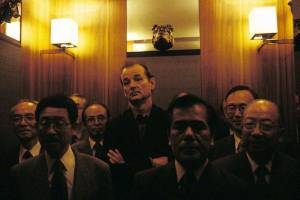
Bill Murray plays Bob Harris, an aging movie star whose career and marriage are passed their prime. The latest stop on his star's descent is a commercial shoot in Japan, an embarrassment perhaps only known to him, as every handler, hotel worker or fan that enters his orbit still glad-hands him like his best years happened only yesterday. His wife sends him carpet swatches halfway around the world to make sure his study has the right shade of burgundy. Bob accepts his life with a sarcasm that’s sadder than it is biting, telling jokes to an audience that doesn’t speak his language. The salad days are behind him and it seems he’s all laughed out. So in essence, Bob is Bill Murray, which is a good thing, because Bill Murray is really great at playing Bill Murray.

Most performances are based on the actor disappearing into the part, but here, Murray’s performance is all the more affecting because you feel like you’re watching him as opposed to a character. Barflies and passers-by approach him and gush over how much they love his work. He sees his faced plastered across skyscrapers and vehicles. The viewer has to wonder how many times such things have happened to Murray in real life, and how it must feel to be constantly reminded of your public persona. Even the names of the actor and character are suspiciously similar. As Harris, Murray brings the kind of honesty and vulnerability that make it obvious why Coppola wouldn’t have made the film without him.

Murray’s counterpart is Charlotte (Johansson), a young philosophy graduate dealing with an equally lifeless marriage. She jokes about Bob’s midlife crisis even though she’s hit hers a few decades too early. Charlotte is part of a generation of creatives who are given the world on a platter, but can’t seem to find their place in it. She’s self-critical as a writer, and wryly observes that being a photographer is just a phase all girls go through, “like horses”. There are numerous shots of Charlotte staring out of her hotel window at the Tokyo cityscape, looking for something, even if she's not sure what that something is yet.

Self-discovery in a foreign land is an enticing little fantasy. The idea of breaking out of one's established culture by absorbing the best parts of another is what kept Eat, Pray, Love on bestseller lists for three years. Coppola recognizes and attacks such an impractical solution to personal identity with both humour and frankness. The idea of fast-food cultural consumption is best satirized via an oblivious young starlet played by Ana Faris, who incorporates aspects of Japanese culture into her identity with seemingly little understanding of what they actually mean. When Charlotte admits to feeling nothing after watching a Japanese ceremony, foreign religion being the sort of fashionable thing sightseers pick up like a fake accent, it becomes clear that the setting of the film is merely incidental; this is a film about connecting with people, not places.

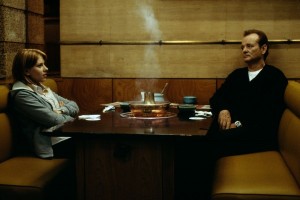
With so much of the actual developments happening internally, the real action in Lost in Translation plays out in the repartee between Bob and Charlotte, which starts with the usual complaints about American-Japanese culture clash. Bob cracks jokes about Japan’s food and language while Charlotte seems to be the only person capable of talking to Bob Harris the person instead of Bob Harris the movie star. Coppola writes maybe one or two too many of these “ain’t Japan weird” scenes, but they reinforce the alienation of the characters and how much of a relief one another’s company is. Their conversations gradually become less sweetly sardonic and more personal the longer the two are together . In the film’s most pivotal scene, the pair lay in bed side by side as Charlotte confesses to being stuck in life, with Bob giving advice as best he can. Coppola is content to just let camera hang over them as Charlotte stares up at the hotel ceiling, which doesn't seem so bland and empty when you're sharing it with the right person.

It’s easy to see where the film’s setup could lead, but thankfully, Coppola knows exactly what her movie is about. Her characters have emotional problems and they need an emotional respite, not a physical one. Whatever amount of sexual tension there is for the viewer to decide, Charlotte’s looks serving mostly as a contrast to Bob’s, her baby blues opposite his pale, weary eyes. Their age difference is largely inconsequential, save for some ribbing at Bob’s expense, and in place of a May-December romance, we get a friendship between two people at the same place in different seasons of their lives.

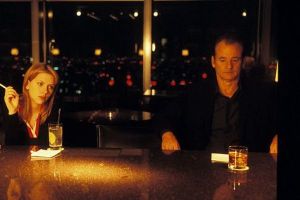
The other real star of Lost in Translation is Japan, which is a constant marvel to watch. The muted tones of the hotel seem a paradox when housed in the otherwise vibrant downtown of Tokyo. When Bob first enters the city, there’s a childlike fascination in his face as he stares out at a city that’s half New York, half circus. As the leads share drinks in a bar early on, the bright lights of the Shinjuku ward broadcast the sleepless activity just outside. The frenetic neon sprawl of the city is juxtaposed with a trip to Kyoto which is almost otherworldly in its tranquility. There’s a regimented pace to each set piece, almost as if the camera is acting as a tour guide, pinpointing all the major highlights. Japan is captured with such loving detail that it’s hard to think about the film being set anywhere else, despite the story's freeform nature.

Coppola’s film has no great dramatic twist, and instead just focuses on how two very sad people make each other’s lives a little more bearable. Yet there’s a cruel aftertaste to every laugh shared between Bob and Charlotte, because it’s known from the beginning that this is a relationship that isn’t meant to last. When the two finally do say goodbye, it’s a moment of almost unparalleled bittersweetness. For a film to make you feel anything by the end is an achievement, but Lost in Translation manages to stir your emotions on two fronts, leaving you heartbroken at the sight of such a beautiful friendship ending, but also joyful, because you got to experience it.

5 out of 5

Directed by Sophia Coppola

2003, USA

In F*ck Yeah! (5 out of 5), Reviews Tags Ana Faris, Bill Murray, Eat Pray Love, Lost in Translation, Scarlett Johansson, Sophia Coppola
Comment

Review: Zodiac

September 17, 2012

Originally Posted June 27th, 2010

For two years, the San Francisco Bay area staged a desperate manhunt to stop the man responsible for a series of bizarre and brutal murders, between 1969, and 1971. In cryptic letters to newspapers, the killer boasted of his attacks, and made a variety of new threats involving school buses and bombs. The man, calling himself The Zodiac, would become a lightning rod for a restless American psyche otherwise occupied with the ongoing war in Vietnam. Yet, before any arrest could be made, the letters stopped, and The Zodiac vanished. With only one other authentic letter appearing in 1974, the crimes of the bay area boogeyman would quickly fade from public consciousness. To this day, the case remains open in three counties, and no arrest has ever been made.

The "one that got away" is a common component of police procedurals, usually involving a burnt out dick warning another detective not to get too deep into the job when doggedly pursuing of a killer. Losing oneself in a mystery can come at the cost of relationships and sanity. The next time you tell someone a really good brain teaser, keep the answer to yourself and see how long it takes for them to try and pry it out of you. This is probably the main reason why filming the story of the Zodiac murders has taken more than thirty years. The killings were shocking, twisted, and captivating, which are buzzwords most producers like to see on a poster. The problem: any film about Zodiac would have no ending. To this day, the true identity of The Zodiac is unknown. Now, imagine how frustrating Se7en would have been if it had ended without ever revealing the killer's identity. So it’s no small feat that David Fincher has taken the investigation that never ended and turned it into one of the best films of the last decade.

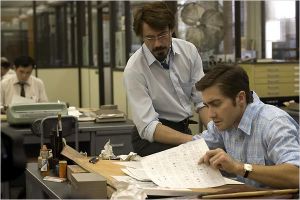
Zodiac’s greatest strength, and some would argue its greatest weakness, is its commitment to portraying the events surrounding case as truthfully as possible. The film is based on the real life accounts of Robert Graysmith, who was a cartoonist at the San Francisco Chronicle during the height of the attacks. Graysmith (played by Jake Gyllenhaal) would become more and more involved in the case as the police investigation died down. His novel of the same name is the blueprint for Fincher’s version, and it is replicated in painstaking detail. Even some of the stranger facts, such as the curiously large number of sweaters worn by Zodiac victim Michael Mageau, are included to make the stranger than fiction details of this real case all the more puzzling.

The film covers more than twenty years, starting with the first Zodiac letters and extending all the way into the 1990’s. In retelling the accounts chronologically, the majority of the film’s action sequences take place within the first hour, and even then there are only a handful. By the time lead detective Dave Toschi (Ruffalo) appears to investigate the one and only confirmed Zodiac killing in San Francisco, audience members should be prepared for an onslaught of the red stuff, and I mean tape, not blood.  This is a film where the big police victory isn’t getting the man, but is instead getting a warrant. The attention to detail given to the investigation will probably discourage viewers used to watching police paperwork covered in a quick montage.  “No need for due process right,” jokes Toschi after watching Dirty Harry, whose villain was based on Zodiac. While certainly less sexy than an episode of CSI, putting the viewer in the thick of the investigation’s minutiae properly emphasizes how easy it is to get crushed under the day-to-day of working on one case.

It’s difficult to convey to viewers how exhausting time can be in a film. A fade out can cover unfathomable amounts of time in a matter of seconds, with the audience being no worse for wear. Spanning more than three decades, Zodiac is one of those rare films that makes you feel the weight of time passing as the investigation begins to slow down. At over two and a half hours, Zodiac will test your endurance. A skyscraper is literally built before your eyes during the time between major breaks in the case. In a brilliantly constructed transition, darkness is set to the cycling sounds of pop songs and headlines from 1972, through 1977, covering America’s “Horse with no name” to The Ohio Player’s “Love Rollercoaster”. In that time, the war in Vietnam ended, and America had a new pet serial killer, the Son of Sam (who had a TV movie less than a decade after being arrested). By the third act, it seems like everyone, including Zodiac, has moved on.

This is where the film picks up speed and moves from police procedural into territory more commonly found in modern thrillers, with Gyllenhaal’s Graysmith taking over the investigation. There’s still plenty of paperwork mind you, but as Graysmith and the case slowly start to unravel, there’s a sense of foreboding that gives reading old police reports a kinetic energy bordering on full-blown frenzy. Gyllenhaal proved himself capable of a slow-burn performance in DonnieDarko, but here, his transition from boy-scout cartoonist to obsessed detective is backed by visible signs of depletion, as his fresh face slowly darkens from restless nights spent hunting a killer the world has forgotten. The soundtrack shifts from era appropriate pop songs to morbid piano pieces, all while San Francisco is caught in a never-ending rainstorm. It’s not long before Graysmith begins receiving mysterious phone calls, and it appears his life is in danger. The tension reaches a crescendo in a scene inside a California basement. It’s one of the most suspenseful and terrifying ever filmed.

Beyond the facts of the Zodiac case, the film reaches into some fairly well worn territory about the way police work stresses relationships with family or coworkers. The friendship between Graysmith and criminal reporter (and one-time Zodiac target) Paul Avery (Downey Jr.) is mostly fictionalized, but their various tête-à-têtes make for some light comic relief. If Fincher is to be faulted with anything, it’s that he cheats a bit with his ending. The film gives a certain amount of closure to the killer’s identity, which, while true to Graysmith’s book, doesn’t properly do justice to the reality, which is far more intriguing. I had never heard of the Zodiac murders until watching this movie, and in a way, I wish I never had. The world let go, and it seems that we’ll never know the truth behind who the Zodiac really was. It’s an answer that I may not like, but it’s one I won’t be forgetting anytime soon.

5 out of 5

Directed by David Fincher

2007, USA

In F*ck Yeah! (5 out of 5), Reviews Tags David Fincher, Donnie Darko, Jake Gyllenhaal, Mark Ruffalo, Robert Downey Jr-, Robert Graysmith, Zodiac
Comment
jack-and-jill.jpeg

Review: Jack and Jill

August 21, 2012

Originally Posted November 12th, 2011 

It’s getting easier to believe that Adam Sandler has been orchestrating some Andy Kaufman-esque prank over the last few years. After America’s tepid response to his more dramatic roles in films like Funny People, perhaps Sandler decided that the best revenge was to give the people exactly what they want: shallow, inoffensive fast-food comedies like Grown Ups and Just Go With It, that, despite all evidence pointing towards their mostly meritless existence, still gross over $100 million. The hope was that these films would make his comeback as a dramatic actor all the more incredible but with Jack and Jill, the most reprehensibly lazy cash-grab yet to bare the Happy Madison name, what little dignity Sandler had left is publicly flayed, and it’s entirely his own fault.

Then again, you didn’t really need me to tell you that did you? The concept of a movie where Sandler plays his own twin sister is parody, maybe deserving of a five minute SNL sketch, yet here we are, with a 90 minute film all about Sandler dealing with his identical twin sister over the holidays. According to the filmmakers, twins are just the wackiest thing in the world, and you’d better think so to if you want to wring any enjoyment out of non-stop gags about twin powers, secret languages and Sandler mirroring himself on screen. No seriously, that’s the joke, there’s two of him and he’s doing the same thing, but one of him’s a lady!

And what a lady he is. Sandler’s been criticized for his over-reliance on characters with silly voices, but either he’s not listening, or just doesn’t care, because Jill is like the muse from which all those stupid voices and characters have originated. Oh sure, she’s loud, abrasive, and in all likelihood, mentally disturbed; that’s kinda the point of her as a catalyst for mayhem. She jumps from oblivious to shrill to psychotic and back again, often within the same scene, but when the filmmakers try to turn our disdain around on us to make you feel sorry for her, it’s insanity. Endearment in the writer’s eyes is Jill’s inability to remember movie titles correctly, and having a pet macaw named Poopsie. This is a repugnant, loathsome creation, devoid of any ounce of sympathy and one that I can only pray is too absurd for real life.

Granted, Jack and Jill’s version of L.A. seems overrun with gross comic characterizations that are often more frightening than funny. This is a world where someone almost gets the crap kicked out of him because he’s an atheist; not because he’s belittling the beliefs of others, no, just being atheist is grounds enough to be violently threatened. But hey, you book John McEnroe, you get him to yell at someone, because that’s still funny, right? Then there’s Sandler’s daughter, who creepishly carries around a doll dressed as herself through the entire film, which gets stranger and stranger the longer the movie goes without someone commenting on it. That’s not a character trait, it’s just weird, and Katie Holmes as Sandler’s wife is the closest thing to a sane voice in the film, though her refusal to acknowledge the utter nonsense around her probably makes her just as complicit in it.

Finally, there’s Jack, who should theoretically be the one identifiable person in this freak show, but is instead the most unlikeable everyman of Sandler’s increasing catalogue of lifeless family men. While having to exist in the same universe as Jill might be an excuse for frustration, it doesn’t explain why Sandler though it would be clever to play Jack as a raging, manipulative asshole, made abundantly clear through his cruelty to all those around him, particularly his employees. Oh by the way, he’s an ad exec, which might be a meta-commentary on the absurd amount of product placement in the film, but it'll probably just top-off your hatred for Jack as a human being.

Sandler just seems pissed off whenever he’s not in drag, which I think is coming from a very real place (no, not like that). Here we see Sandler looking at himself, or rather, the shtick-peddler he has become, and you can sense his frustration, with Jill embodying the kinds of sell-out characters he’s resorted to making as an appeal to a common denominator that couldn’t be any lower if it were subterranean. You just know that Sandler isn’t happy with this project, and worse, he knows that you know, hell, everyone seems acutely aware that this will be the career nadir for dozens.

It’s like watching a death row inmate relive his past crimes; you can sense his regret, but if he can’t forgive himself, why should we? And if this is Sandler’s execution, at least all his friends came by to observe it. The celebrity cameos are relentless, with usual suspects David Spade and Nick Swardson joined by pop culture throw-aways like Shamwow Guy and Subway’s Jared. But it’s not just the hacks Sandler roped in; Johnny Depp and Norm MacDonald are both palpably embarrassed in brief cameos, but at least the fleeting thrill of seeing them onscreen is a nice diversion. The big gun really is Al “Yes I have an Oscar” Pacino, in what’s probably his most fearless role in years. Playing himself offers up myriad easy jokes about his great roles of old, and he’s still woefully underserved by the script, but god love him for putting so much damn effort into this. It’d be easy to compare Pacino’s career spiral to Sandler’s, but at least here, Pacino dives into the material earnestly, almost sacrificially, in an effort to inject something, anything, resembling fun into this disaster.

Spoilers be damned, I can’t think of a better way to sum up my thoughts on Jack and Jill than to paraphrase the closing dialogue of Jack and Pacino as they watch their atrocious, quote-destroying Dunkin’ Donuts collaboration, an ad that is supposed to be the film’s big triumph:

Sandler: So what’d you think?

Pacino: Burn it. Destroy every copy. No one can ever know that this existed.

It’s not hard to figure out what Pacino and Sandler are actually talking about, the only question is whether this admission is more funny or pathetic. I’d side with the latter. There’s little about Jack and Jill that you could describe as funny.

1 out of 5

Directed by Dennis Dugan

2011, USA

In Oh God (1 out of 5) Tags Adam Sandler, Al Pacino, Dennis Dugan, Funny People, Grown Ups, Jack and Jill, Jack and Jill review, Johnny Depp, Just Go With It, Katie Holmes, Norm MacDonald
Comment
the-muppet-movie-1979-02-645-75.jpeg

Review: The Muppet Movie

August 21, 2012

Originally Posted November 23rd, 2011

Jim Henson’s iconic felt creations, the Muppets, skyrocketed in fame pretty much out the gate, going from sidekicks on Sesame Street to prime-time fixtures with a speed most meat-bag TV stars would envy, though in retrospect, it’s not surprising. If you’ve never seen The Muppet Show, you owe it to yourself to watch it, because it’s really something special. Wholly enjoyable for viewers of all ages, the show’s combination of brisk skits, musical numbers and special guests might not sound all that different from your average late-night show, but Henson’s secret weapon is all in the title, the Muppets themselves.

With a bench of great characters as deep as Disney or Looney Tunes, the show-within-a-show format made Kermit and company more relatable than you’d think possible for a bunch of puppets. The “let’s put on a show” mentality of the Muppets made them entertainers like Carson or Letterman, not just comic creations, and it's almost effortless to forget that you’re not really watching a fuzzy frog telling jokes or playing the banjo. Perhaps that’s why The Muppet Movie is such a joy to watch, because you get to see how all this wonderful silliness got started.

Well, sort of. True to the show, the film finds the gang watching a private screening of The Muppet Movie, which follows “approximately” how the Muppets came together. Opening with Kermit strumming away in a swamp to “Rainbow Connection”, the frog of many talents impresses a passing agent from Hollywood. That’s right, Hollywood! When Kermit hears there’s an open casting call at World Wide Studios for frogs looking to be rich and famous, it doesn’t take long for the little guy to be off on his way to California.

Now, despite how absurd a job opportunity that may sound and how vaguely untrustworthy Dom DeLuise is as the silver-toothed big-city man, the film from the get-go is unapologetically earnest and optimistic. Kermit, though initially reluctant to leave his happy existence in the swamp, can’t pass up the chance to make millions of people happy, and if that means taking your shot on an ad that sends you all the way across the country, so be it. Those hopes pay off early as it turns out, with Kermit making quick friends with fellow Muppet Fozzie Bear, whose rusty old Studebaker gets the pair’s road trip proper on its way.

The trail to LA is laden with most of the key Muppet performers, and it’s fun to see introductions that are on the nose (Ms. Piggy’s grand entrance is, of course, a beauty pageant) mixed with more absurd ones (Gonzo starts off a plumber dreaming of movie stardom...in Bombay). The checklist of character collection is solid structurally but the film’s middle can sag when the conniving Doc Hopper keeps popping up to try and capture or kill Kermit. Though watching Charles Durning play the Colonel Sanders of frog legs has its moments, his inclusion is mostly just to give the film a villain and a sense of danger.

It’s by no means stunt-casting though, as this being the first Muppet adventure set in the real world gives licence to empty the show’s exhaustive rolodex of guest comedians and celebrities that sets a high bar for cameo frequency, as well as quality. You get nice pop-ins from the likes of Bob Hope and Richard Pryor, in addition to more involved appearances, like Steve Martin as a short-tempered, short-short wearing waiter, and Mel Brooks throwing on his best silly accent as a mad German scientist who specializes in frog mind control (a very rapidly growing field). The capper has to be Orson Welles as studio exec Lew Lord, who has just one line of dialogue, but on a per-word basis, makes it one of the most memorable cameos ever filmed.

What’s most surprising is that despite being 30 years old, the script is exceptionally air-tight. There are plenty of great groaner puns, running gags and self-references, but the jokes from the actors (both fabric and fleshy) all still work because their routed in solid word-play and supreme comic timing. There’s also the Oscar nominated music that’s as infectious as ever. Though most remember “Rainbow Connection” as the film’s big number, Kermit and Fozzie’s practically life-affirming “Movin’ Right Along” will have even the most curmudgeonly audience members toe-tapping along with grins on their faces.

It’s just really hard to take issue with The Muppet Movie; its minor pacing issues are mostly ignorable thanks to a brief runtime, but you won’t even notice them with a cast of characters this loveable and a tone that inspires nothing but warm and fuzzy feelings. When what is ostensibly a kid’s movie finds equal enjoyment among adults, it's no small achievement, but for it to remain that way for three decades is something else entirely. This is the movie that will make you fall in love with the Muppets, though it’s not like that's ever been such a hard thing to do in the first place.

4 out of 5

Directed by James Frawley

1979, UK/USA
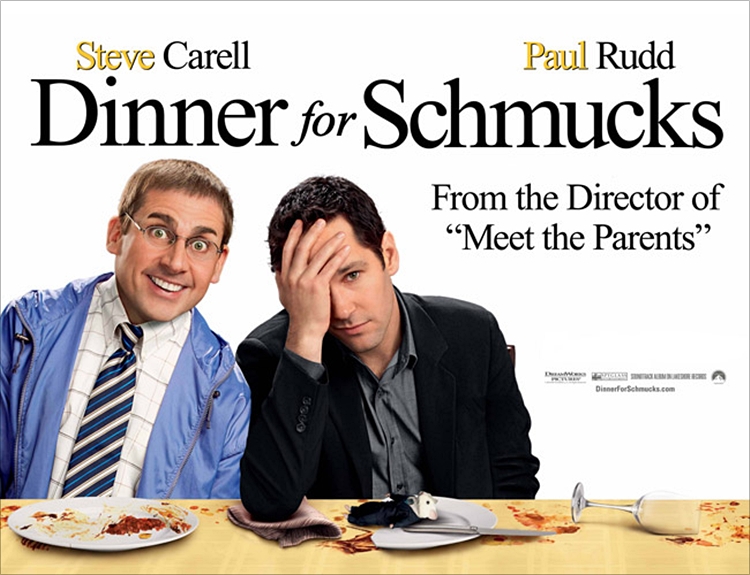
In Yeah! (4 out of 5) Tags Charles Durning, Dom DeLuise, James Frawley, Jim Henson, Mel Brooks, Orson Welles, Richard Pryor, Sesame Street, Steve Martin, The Muppet Movie, The Muppet Movie review, The Muppets
Comment
a_very_harold_and_kumar_christmas.jpeg

Review: A Very Harold & Kumar 3D Christmas

August 20, 2012

Originally Posted November 5th, 2011 

Since their smoke-filled entrance in 2004, the “Harold and Kumar” films have been easy to like, something that can’t be said for most comedies that take aim at social norms and political correctness the way this franchise has. Despite all the insane stoner antics and gleefully racy jokes, the relatable friendship between Harold (John Cho) and Kumar (Kal Penn) provided a solid emotional core for the mayhem to build off of, and the absolute necessity of its stars has kept the brand largely undiluted by DVD prequels and spinoffs. So it’s only fitting that their latest adventure sets its sights on the warmest and cheesiest of genres, the Christmas movie, pulling out all the stops in a total disregard for the sanctity of the holidays, and it gives the well-worn pot and stereotype material a much needed boost.

A Very Harold & Kumar 3D Christmas picks up six years after “Escape from Guantanamo Bay,” which puts Harold and Kumar much closer in age to their real life counterparts, but further apart socially than we’ve ever seen them. Kumar hasn’t abandoned the bohemian dream of responsibility-free binge smoking, even though Harold has left him for a good job and a hot wife with an absolutely terrifying father (solidly played by Danny Trejo, who brings his trademark so-scary-it’s-funny glowering). A chance reunion of the boys caused by a mysterious package for Harold left at Kumar’s door leads to a mishap that sends the pair off on the most festive of quests: finding a Christmas tree.

The holidays are the perfect background for stories of reunion, and writers Jon Hurwitz and Hayden Schlossberg manage to wring out some nice moments of self-awareness when the drug-fuelled escapades keep getting buzz-killed by the assumption that the characters should be growing up. It’s been seven years since “Go to White Castle”, and as Harold knowingly points out, most people lose half their friends in that time, something franchise die-hards may consider when remembering who they watched each film with. To say that the series has been a poignant commentary on maturing relationships might be a stretch, but it’s great to see a buddy-comedy willing to look at how friendships often don’t remain in a static bubble the way that most movie ones do.

Granted, all of this is really secondary to the jokes, which should satisfy fans of the previous films despite being mostly retreads of earlier gags, redressed in a holiday theme. Sex, race and drugs continue as the prime sources of inspiration, but with an increased focus on meta-humour, including a nice dig at Penn’s stint with the White House and a litany of jabs at 3D (more on that in a bit). The Yuletide spirit really elevates the material, with a tired “someone spiked our drink” gag acting as an excuse for an extended homage to claymation specials, and the movie has what’s probably the best A Christmas Story reference you’re like to see in an R-rated film.

The holiday trappings extend into the film’s structure, which uses the often continuity-free magic of a Christmas special as the perfect reason to lean into the series’ increasingly prominent weird side. The shots of coked-out babies, Jesus and a resurrected Neil Patrick Harris that made it into the trailers all come together in a plot that’s not just coherent, but well-paced, moving Harold and Kumar from one absurd comic setpiece to another with great economy. As in the previous films, Neil Patrick Harris is a real highlight, as his revived career only gives him more reason to be a crack-addled womanizer who resembles a sexual predator more and more with each movie.

And in addition to embracing the holiday spirit, the 3D tag in the title is no afterthought, as this is about as great an apotheosis of the technology as there ever will be. Bong smoke billows out at every opportunity and the various objects and fluids shot out at the audience are great gags in and of themselves. It’s a cathartic last hurrah for anyone tired of the extra dimension, but of course, this will likely limit the film’s rewatchability, as the 3D money shots won’t play with the same effect on a standard TV. Still, as a send-up of Hollywood’s most tiring trend, the constant winking at the camera plays well, even without the added depth.

It’s a real rarity, but A Very Harold & Kumar 3D Christmas manages to breathe life into its well-established formula by using the same tricks that reek of desperation in other franchises. By committing to the Christmas movie formula and exploiting 3D to its gloriously stupid limit, a coda to the trilogy is enjoyably achieved. Though a sequel is always an option, leaving these characters as is will no doubt place “Harold & Kumar” among the greats of stoner comedies.

4 out of 5

Directed by Todd Strauss-Schulson

2011, USA

In Reviews, Yeah! (4 out of 5) Tags A Very Harold & Kumar 3D Christmas, A Very Harold & Kumar Christmas Review, Danny Trejo, Harold & Kumar, Harold & Kumar Go to Guantanamo Bay, Harold & Kumar Go to White Castle, Harold & Kumar Review, Hayden Schlossberg, John Cho, Jon Hurwitz, Kal Penn, Neil Patrick Harris
Comment

Review: The Darkest Hour

August 19, 2012

Originally Posted December 27th, 2011 

The Darkest Hour is a film recommendable to anyone looking to take their first crack at screenwriting, because it is, in so many ways, the result of writers hoping a cool concept will cover up their poor handling of every other aspect in storytelling. Although plenty of good movies have gotten away with a good idea hiding the weakness of mechanical nuts and bolts, The Darkest Hour consistently shows an amateur understanding of plot development, character depth, motivation, and everything in between. It buries any novelty in its premise with cliché, wooden dialogue and just plain stupidity.

The shortcomings of the script are apparent from word one. You've already lost me if the characters are introduced as being either so bland, or so obnoxious, that you think they're the prologue cannon fodder instead of the leads. When their iPhone App designed to help hot strangers stalk each other doesn't get the $10 million dollar investment they were promised in Russia, is that supposed to make them sympathetic? Not when they're inept enough to fly out to Moscow without an NDA (in the film's own parlance, "non-douchebag agreement"), and just accept that they have no legal recourse because, "it's Moscow."

Having had their dreams of being overnight millionaires tragically crushed, techie Ben (Max Minghella) and slacker-waiting-for-a-chance-to-prove-himself Sean (Emile Hirsch) take comfort in a club modelled after a Russian Standard ad (picking up a few fellow American gals along the way, of course), before the power goes out and a mysterious light pattern overtakes the Russian night sky. There's an out of focus orange aurora borealis shot as if on a completely different planet than the one the awed street dwellers are standing on, but as sparkly orbs of light descend from the sky, mild relief sets in, as we're finally getting to that nugget of promise from the trailers.

An alien invasion is by no means a very original plot, but the alien designs in The Darkest Hour — or lack thereof — are. Aside from a slight shimmer, the aliens are completely invisible, which is made all the more dangerous for the residents of Moscow when the extraterrestrials prove hostile and start stealing the city's electricity. Getting in close contact with one of these things turns people into bits of burnt newspaper, and the instant ash-ification of party-goers is enough to convince our heroes to lock themselves away in a restaurant supply room for a few days.

At this point, a few good ideas present themselves; the change in scenery alone earns The Darkest Hour some credit. There are only so many times you can see New York, L.A. and Chicago decimated before all such films start running together. A well-handled montage covering the few days the characters stay in isolation sets up a refreshing look at the after-effects of an alien invasion as opposed to the immediate ones. And despite how cheap it might sound, having an enemy that could literally be behind you at any moment sounds pretty terrifying.

Too bad when it comes to actually executing on these ideas, The Darkest Hour falls on its face repeatedly with blunt exposition and poor storytelling devices. The early alien encounters mostly exist to establish some rules about the invaders, which is made pretty apparent when characters spout a theory about the creatures only to have it conveniently proven in the exact same scene. Visually, the only Moscow you get to see comes from matte backgrounds and scene after scene of dull industrial back alleys that could use a good feather-dusting.

That the characters lack any personality is mostly forgivable given the dire circumstances, but that doesn't excuse their nonsensical motivations. How exactly would the U.S. embassy be the one safe zone amidst all this destruction? What does a militia group gain by protecting a group of random strangers? Why would you risk your life finding someone who understands a Russian radio signal when you're just as likely not to understand the translator? Granted, with an English-speaking population of around 5%, the Yank survivors practically win the lottery with the number of bilingual characters they encounter.

All of this would be thoroughly more bearable if the one cool thing The Darkest Hour brought to the table had been better developed. The transparency of the aliens is more threatening in theory than practice, as you know everyone is safe so long as we don't see a set-up for a shot of someone getting turned into dandruff, an effect that loses most of its impact by vaporization number four or five. As a means of giving spatial context, having the aliens set off electrical equipment around them is pretty clever but it means their presence is always loudly announced by car alarms and flickering lights. I feel nothing for these characters, the least you could do is make their demises unexpected in some way.

The film's back half is ridden with clichés, including: deus ex machina via military types, emotional speeches to convince people to do incredibly dumb things, deus ex via character reappearance, inconvenient weapon malfunctions, painfully obvious introduction of a plot device for completely unexplained use as a deus ex, and that's not even the half of it. It wasn't until the forced happy ending and sequel baiting moments before the credits that I just gave up and started revelling in The Darkest Hour's ineptitude. Look, we all think it's the easiest thing in the world to write a dumb action movie, but The Darkest Hour proves that even when we think they're at their worst, bad Hollywood blockbusters could be so, so much worse.

1 out of 5

Directed by Chris Gorak

2011, USA

In Oh God (1 out of 5) Tags Emile Hirsch, Max Minghella, Olivia Thirlby, The Darkest Hour, The Darkest Hour review
Comment

Review: The Sitter

August 18, 2012

Originally Posted December 12th, 2012 

Flashback to 2000: 26 year-old David Gordon Green gets distribution for his debut feature, George Washington, which cost less than $50,000 to make. The film is met with wide critical praise and makes an appearance on Roger Ebert's list of the year's ten best films. Peter Travers remarked that Green was, "a writer and director of rare grace and feeling."

Now flashforward to the release of The Sitter, andyou'd be forgiven for wondering what exactly became of the celluloid poet people talked so highly of. His second comedy this year, and the coda to a stoner-trilogy that started in 2006 with Pineapple Express, the drug of choice may have changed, but The Sitter is the same blend of ludicrous scenarios and foul-mouthing that you've seen from countless lesser directors, and it's just as anemic coming from Green.

Not that the film is lacking for a good hook to inspire all the "one crazy night" antics. Perpetual screw-up Noah (Jonah Hill) must get from the New York suburbs to Manhattan so as to fulfill his girlfriend's cocaine needs. He's willing to ignore the completely one-way nature of their relationship because of the promise of sex that comes with it, to the point that he's willing to drag the three kids he's in charge of babysitting along for the ride. And wouldn't you know it, when those kids include a club-obsessing would-be starlet, a preppy but panicky time bomb and a wander-lusting master of regular bombs, things don't go quite so smoothly for Noah. Comic misunderstandings involving police, potential sex partners, and psycho drug dealers, ensue.

Call it Adventures in Babysitting meets Harold & Kumar Go to White Castle. Adding kids to the mix offers mild freshness to the well-worn story of a simple task made obscenely difficult, and for the first half of the film the children mostly just steer Noah off course and start the plot element chain reactions. Those elements don't really go into any new territory mind you; the cokehead that Noah runs afoul of, Karl (Sam Rockwell), falls neatly in the ranks of other bug-eyed dealers with odd affectations and any unexpected turns are made that way through contrivance. When trying to desperately gin-up $10,000, Noah's plans seem to ignore the car he's already stolen that's worth five times that amount.

Events have a habit of playing out without much thought as to how things got there. Jump five minutes and the film goes from a restaurant, to a Bat Mitzvah, to a diamond heist, with the writers placing priority on creating the crazy situations first, and hoping the other elements develop in the execution. They rarely do, and while, yes, being trapped in your car by a roving gang of body-builders is pretty funny in concept, it would help if the possibilities of such a scenario were explored beyond just existing. It creates long stretches that register without laughter because the film doesn't have enough jokes, let alone good ones. First time writers Brian Gatewood and Alessandro Tanaka never take time for set-up, and let moments that should be punctuated by jokes instead be filled with looks of exasperation and more swearing.

Granted, when you need someone to act stressed and deliver stream-of-consciousness cursing, Jonah Hill's a fine choice. He's an affably uncommanding presence, as even his moments of success have a nervous quality to them, but he can play immature without resorting to petulance, which makes for a likeable lead. He's a solid anchor for the rest of the cast to play off of, particularly the kids, who make the surprisingly sweet heart-to-heart talks some of the film's better moments. A scene shared between Noah and his no-show of a father borders on poignant, and for a moment, it seems like we're seeing The Sitter intersect with another, more observant, movie from Green.

The rest of the cast is strong once given the opportunity to do more than just react wildly to the given situation, and standout moments give the impression of untapped potential (Method Man, as always, is a great addition). At only 81 minutes in length, it's questionable whether or not the film would have benefitted from additional footage. It certainly would have helped the haphazard editing that causes jokes to misfire and characters to appear at a moments notice, but barring a complete plot restructuring, there's really not much more to this premise than is present.

Wishing a film was funnier is a pretty vague complaint, but if you're giving people the same story they've seen a dozen times before, you need to justify it, and the jokes presented here simply don't. There's just not enough humor or intrigue making a case for the existence of The Sitter, and for a film all about living up to your expectations, it looks like Green is doing anything but.

2 out of 5

Directed by David Gordon Green

2011, USA

In *Yawn* (2 out of 5), Reviews Tags David Gordon Green, Jonah Hill, Method Man, Sam Rockwell, The Sitter
Comment

Review: Red Tails

August 17, 2012

Originally Posted January 21st 2012 

There’s a scene early in Red Tails where two American fighter pilots are tracking a sputtering enemy plane back to a Nazi airfield. With the element of surprise on their side, the men of the 332nd fighter group start raining hellfire down on the German men and equipment. Every combustible element within a square mile blossoms into flames, and the Americans head home with a decisive victory. One of the Nazis looks on in disgust as the planes make for the horizon, the burning copses of his comrades all around him. “My god,” he says, “Those pilots were African!”

It’s that hawk-eyed attention to skin colour that’s supposed to make Red Tails stand out. It dramatizes the story of the Tuskegee airmen, the first African American pilots to see active combat in World War II, and the inequality that would confront them daily. The institutional racism that was embedded in the war effort under the Jim Crow laws presented a challenge for these men; how do you establish your worth as an equal when the orders you receive are based on low expectations? The intricacies of that conflict are all but ignored by Red Tails, which uses the story of the Tuskegee airmen as paper thin table dressing for an over-stuffed and all too familiar WWII movie.

Things get off to a bumpy start thanks to an opening combat scenario that doubles as a showcase for some grossly distracting credits. Motives and characters aren’t clear beyond the historical context of Americans good, Nazis bad, so it’s mostly just an introduction to the film’s emphasis on the aerial combat. There’s no centre holding the film together early, and once we meet the pilots, listlessly bored from routine flybys in Italy, the volume of characters introduced is overwhelming in number, but not depth.

Each man is your stock WWII character type, referred to mostly by codename, and given a particular affect for distinguishing purposes. Marty “Easy” Julian (Nate Parker) leads the squad, named for an attitude that’s the result of drinking on the job. The minute he grabs his flasks for the first time, you can see his character arc printed on it. Then there’s Joe “Lightning” Little (David Oyelowo), the cocksure aerial ace of daring-do who can’t seem to follow orders, unless they’re given by his Italian-born sweetheart. The film thinks their romance is too cute to make you question how vapid a relationship must be if the two people in it can’t verbally communicate. It isn’t.

The rest of the cast can be boiled down to their archetypes, such as the put-upon mechanic, the eager young guy, the priest, etc. You can see the path each character will go down because the territory has been so well covered by a litany of other WWII films of the same vein, only now the colour of the men’s skin shoehorns racial conflict in place of character building. Terrence Howard playing the group’s Colonel gets many of the more interesting scenes because his character has to confront racism at a bureaucratic level, not just in random encounters with bigoted American soldiers (which it turns out, is most of them). It’s perhaps structurally consistent, if not enjoyable, that when the film tries to portray the ramifications of a segregated military, it’s often as cliché as the rest of the story.

Air combat makes up the majority of the setpieces, and it’s often just as baffling and sterile as other CGI-based flight movies are. Spatial context is rarely established and the planes just end up in situations that struck the writers as cool, requiring the pilots to make awkward declarative statements about what’s happening. And just because your character’s face is smothered by a flight mask, it doesn’t mean it’s okay to give half-hearted line readings. Everyone should hope that if they die in combat, their wingman will have more to say than just a muffled expletive.

George Lucas’ fingerprints as producer are unmistakable. The bright lighting and cramped sets make the pilots look like they’re G.I. Joes on a play set, and no amount of wipes and fadeouts can mask how many scenes end right after the bottom has fallen out. Oh, and there’s also the world’s fastest prison break plot thrown in for good measure, because why stick to one WWII subgenre when there are so many others to crib from?

Perhaps it’s hard to get too angry at Red Tails because it so completely sticks to convention. Following the established war movie playbook keeps it from becoming aggressively awful and some of the explosions look pretty decent. But by no means is Red Tails satisfying either; it’s far too safe in its storytelling, and at times, so eye-roll inducing, chances are you’ll spend more time looking towards the real sky than the virtual one.

2 out of 5

Directed by Anthony Hemingway

2012, USA

In *Yawn* (2 out of 5), Reviews Tags Anthony Hemingway, David Oyelowo, George Lucas, Nate Parker, Red Tails, Red Tails Review, Terrence Howard
Comment
this-means-war-movie-poster-698521.jpeg

Review: This Means War

August 16, 2012

Originally Posted February 19th, 2012

Imagine, if you will, a man of mystery. He’s someone you hire, a mercenary of sorts, and he’s often employed by powerful and wealthy corporations. His job takes him around the world to fulfill contracts that usually involve gunfights, car chases and explosions. And he’s known only by a codename. I’m of course talking about McG, director of two Charlie’s Angels pictures, a mostly tolerable football melodrama, and the red-headed stepchild of the “Terminator”franchise, Terminator Salvation.

McG’s style, so to speak, emphasizes the kind of shallow and insubstantial gratification you often associate with another brand of mass consumption starting with "Mc". So it’s really not surprising that his latest film, This Means War, continues the tradition of all-encompassing vacuousness. The real shame is that even without the shackles of franchises and true stories, McG still decided to make This Means War play like a bland remake/sequel to an entire genre; specifically, bad romantic comedies designed for an insidiously strategic strike on those deflated by another unfulfilling Valentine’s Day.

The vitriol of that sentence might have some of you pumping the brakes on your evening plans but others might be a bit confused. Isn’t this that movie about the two spies who abuse their professional skills and gadgets in order to sabotage one another when they wind up dating the same girl? That statement is all true, but the spy element is so brutally squandered, it’s practically an afterthought. Prepare yourself for a film straight out of a parallel universe where Stephanie Meyer cribbed most her ideas from Ian Fleming instead of Anne Rice.

It’s the age old dilemma that targets two of the four quadrants of film marketing, while flipping off the other two: which ridiculously hunky guy do I want? The one posing that question is Lauren Scott, a well-off urbanite who just can’t seem to get her love life together, despite the fact that she has a stable job, good friends, and is played by the obscenely cute Reese Witherspoon. Looks alone aren’t an indicator of relationship potential, but remember, this is a McG production, so physical attractiveness is the only trait of interest.

The beau’s vying for Mrs. Scott’s affections are the equally stunning Tom Hardy and Chris Pine, best friends and co-workers, but polar opposites so as to cover as wide a swath of romantic tastes as possible. Pine is the libidinous playboy alpha male with a tragic past (think Capt. Kirk, minus the heroism), who lives under a literal glass ceiling that’s somehow more demeaning than the figurative one. Hardy is then tasked with playing the sweet but sensitive yin to Pine’s cock-sure yang, complete with an adorable son and an ex-wife that he still holds a flame for. Is it a spoiler when basic character descriptions practically scream out how the film’s big “quandary” will be resolved?

Now there’s actually something grimly funny about the CIA funding an expensive and clandestine pissing contest, supported perhaps by the film’s blithe disregard for the morality of misappropriated public funds, institutional use of torture, and the existence of a surveillance state. Intercepting every phone message and private conversation a woman has is really just a logical progression of Facebook stalking in the writer’s eyes. But make no mistake; the spy trappings are really just there to make the boys look dreamier by virtue of having the world’s sexiest job.

Granted, McG’s opening action sequence atop a Hong Kong hotel is such a blur of messy choreography and poor CGI that you understand why he’d opt to fill the movie with date scenes instead of shootouts. Lauren’s double trouble all but causes every scene to repeat itself, once with Hardy’s Tuck, and then again with Pine’s Frank. The dates are designed as eye candy, plain and simple, whether they’re set in one of those clubs that only exist in liquor commercials, an intimate warehouse filled with Gustav Klimt paintings, or at Lauren’s tooth-rottingly colourful office. It would remind you of a circus, were there not already a carnival date scene that proves clowns know how to paint using earth tones.

Obviousness is the film’s cardinal sin, the bad cologne pervading every clichéd romantic entanglement and cookie-cutter action sequence. When Lauren keeps a paintball gun levelled strictly at the crotch-ular region, is there any question as to the safety of Tuck’s genitals? Even the soundtrack is employed as a giant slap in the face; as if a montage of Frank and Tuck interfering with each other would leave audiences confused as to their intent, The Beastie Boys’ “Sabotage” grinds away in the background.

At least the leads look like they’re enjoying themselves, so if nothing else, This Means War avoids coming off as desperate. It’s certainly guilty of pandering at every comedic beat and never has the gall to pull the trigger on an idea that’s insightful or original, but then again, fast-food filmmaking like this is designed for ease of digestion. It’s perhaps because of its own bottom-feeding ambitions and disposability that This Means War can stay safely among other cinematic confectioner, as easily forgotten as it is consumed.

2 out of 5

Directed by McG

2012, USA

In *Yawn* (2 out of 5), Reviews Tags Beastie Boys, Charlie's Angels, Chris Pine, McG, Reese Witherspoon, Terminator, Terminator Salvation, This Means War, This Means War review, Tom Hardy
Comment

Review: Batman Begins

August 15, 2012

Originally Posted July 12th, 2012

What is it about Batman that makes him so popular? He doesn't have all the powers of Superman, he doesn't have any powers at all really, save for superhuman levels of dedication to mastering the twin arts of violence and intimidation. Spider-man is similarly an orphan, but doesn't let that stop him from cracking jokes. Batman thinks a punchline is goons filing up in an orderly fashion to get their noses broken. And while Bruce Wayne masquerades as a boozing Lothario to keep his identity a secret, Tony Stark acts like a billionaire playboy because he's a billionaire playboy. On paper, it seems odd that the runt of the superhero litter is the one everybody seems to care about.

If Superman is our wildest aspirations for what we could be, Batman is as close to a real life Superman as we dare hope could exist. In exploring that truth at the heart of the Batman mythos, Christopher Nolan had to scrape way all the outlandish fringe elements of the comics and previous movies, and returned to audiences the age-old story of a modern man fighting crime, but now honed to a razor's edge. It's led people to criticize Batman Begins, and its equally engrossing follow-up The Dark Knight, for being overly serious. Fine. If a superhero movie being more than frivolous spectacle is somehow a bad thing, I'll still trade all the campy performances and nippled-Batsuits out there for a complex protagonist and a well-developed plot, featuring strong emotional hooks, any day of the week.

Arguing against having a cast filled with incredible actors, who are willing to approach the material earnestly and with conviction, is like complaining that the chef put too much care and effort into cooking your steak. There's the old saying that someone "was a good Batman, but not a good Bruce Wayne," and vice versa, but Christian Bale, as he did in American Psycho, shows that the two identities are not separate, but really inform a single, deeply damaged whole. And it's the first Batman movie to make the guy in the title the actual star; there's none of that billing Jack Nicholson before Michael Keaton crap here, Bale and Batman are the stars.

Using Frank Miller's revolutionary Batman: Year One as a launchpad for the new Batman legend, the death of Bruce Wayne's parents isn't some romantic call-to-arms in a fight against crime, it's the beginning of a lifelong struggle to understand and stop injustice. That drive is given focus under the tutelage of Ducard, an emissary for The League of Shadows, played with a fatherly sternness by Liam Neeson. Both he and Bruce share a secret life, and both wish to end the evils of the world, but their means differ drastically. As Ra's Al Ghul, Ducard would sacrifice the whole of Gotham City to save the world, but as Batman, Wayne devotes himself to saving everyone. A clash of moral relativism and personal ideology makes run-of-the-mill villain plots to get lots of money or blow something up look like the kind of motive only a rich studio with an effects budget would find relatable.

"Training is nothing. Will, is everything, the will to act," Ducard tells Bruce. Other superheroes are made so by accident or birthright, their destiny is spoon-fed to them. Viewers respond to Batman because he creates his powers; his strength, intelligence and skill are all the result of sheer will and determination. Well, it doesn't hurt that he's got the best SkyMall catalogue of gadgets out there, but as with everything else, the toys are routed in spartan efficiency. The old Batmobile would take up half a city block just to park, but the Tumbler will roll over every other vehicle and park wherever it damn well pleases. He's Batman, there's no time to find a meter!

What makes it so easy to talk at length about the conceptual achievements of Begins is that they all spring forth from Nolan's refined understanding of story-telling and his typically craftsmanlike filmmaking. The plot moves effortlessly from setpiece to setpiece, advancing character arcs and motives between all the comic book theatrics. Goyer and Nolan's script is filled with memorable exchanges, even though they can't seem to resist reusing roughly half of the one-liners as ironic zingers later on. Plus, the film looks incredible (and incredibly real) the whole way through; the production team figured out how to shoot a luminous modern city like Gotham with dread, and didn't have to resort to Tim Burton's patented German expressionism-overload.

Really, frustration with Batman Begins has less to do with the film's own seriousness, and more to do with how seriously other people take it. How this is a bad thing is a mystery. Shouldn't we go into every movie hoping that it can incite such dedication? The film generates more rabid conversation than usual because it was designed to; Nolan plays the long game here, seeding ideas of Batman becoming more than just a man, while making a case for the comic book movie as something greater than disposable entertainment by taking the character and franchise to new heights. Yes, Batman Begins is a really, really great film, but for a lot of people, myself included, it's a reminder that pop culture has the ability to make a lasting impression on you, and become unforgettable. Not bad for a comic book movie, huh?

5 out of 5

Directed by Christopher Nolan

2005, USA

In F*ck Yeah! (5 out of 5) Tags American Psycho, Batman Begins, Batman: Year One, Christian Bale, Christopher Nolan, Liam Neeson, The Dark Knight, The Dark Knight Rises
Comment
the-campaign-poster.jpeg

Review: The Campaign

August 14, 2012

Seeing as they've been the biggest names in comedy for the better part of a decade now, Will Ferrell and Zach Galifianakis had to star in the same movie at some point. So why not now, at at time when political sensitivity is just starting to percolate, and we could all use a break before the real polarizing insanity begins? Their comedic styles practically read like a president/vice presidential ticket: Ferrell quarterbacks as the big gun leading the ensemble, while Galifianakis is the loveable oddball who shows up to support the headliner, if not outright upstage them. Putting these two together is like getting a licence to print money, so if anything, waiting to do a project about a no holds barred congressional seat race at the prime of its relevancy should only make this meeting of comic titans even more of a success.

So why is The Campaign so much less than the sum of all those hallmarks of a sure-fire hit? It's not as if director Jay Roach is unqualified for this sort of material. When he's not shooting R-rated comedies, he's busy making made-for-TV political movies on HBO. And The Campaign does deliver on the brand of jokes you've come to expect from both its stars, with Ferrell playing another inexplicably successful but barely contained man-child, and Galifianakis doing a variation on the preciously optimistic dimwit archetype he does so well, this time with some heinous sweaters and a pair of chinese pugs to keep him company.

The dominant issue might be that the story is designed to keep the pair apart as much as possible. The film opens with Ferrell's Cam Brady campaigning for reelection as a North Carolinian congressmen, even though all he's had to do in the past is just show up, having previously run unopposed. His platform is simple: America, Jesus, and freedom. When a misdialled phone number and a particularly salacious voice-mail land Brady in hot water, his corporate backers (Dan Aykroyd and John Lithgow) start looking for a replacement, which they find in Galifianakis' Marty Huggins, a small town businessman whose eccentricities can be easily confused for folksy charm.

With an opening quote from Ross Perot reminding viewers that, "politics has no rules," plans for a clean campaign are abandoned almost immediately by both parties, as Cam and Marty pander shamelessly while on camera, and orchestrate increasingly ruthless attacks against one another when off. With Ferrell and Galifianakis only interacting during debates and public events, it's the supporting cast they have to bounce of off when out of the public eye, including  Brian Cox as the Huggins patriarch, and Jason Sudeikis as Brady's campaign manager. There's also Dylan McDermott as Sudeikis' Huggins-camp counter-part, though unless there's some secret inside joke at work here, giving his character the same name as the dentist from Seinfeld is just weird.

While the backup players do fine, The Campaign toooften feels like a series of missed opportunities. The breakouts for both leads (Anchorman and The Hangover) had stronger stories to tie together what were essentially sketch compilations featuring a very talented cast. Here though, the plot counts down to the all-important election without actually building toward it. It's practically one great big montage of scenarios and premises related to campaigning, interspersed with direct attacks and retaliations against one candidate or another, and the repetition grows more wearying every time The Campaign hits the same note of politicians doing anything to please voters.

Certain jokes in and of themselves work just fine. There's a kinda clever, kinda offensive take on the southern mammy stereotype that gets some good mileage. And accidentally punching a baby is just inherently funny, as is when they return to that gag, which is even funnier. But they're the few noteworthy jokes sprinkled into a script that relies too heavily on formula in the sketches: get some expletive-peppered exposition out of the way, then establish a gag where everyone can shout out escalating non sequiturs to see which one will be the scene ender. It's tiresome, and doesn't make the most of either the subject matter or the rating. Why bother getting an R when one of the biggest laugh lines comes from an insult that was safe enough to be used on 30 Rock years ago.

The hit or miss humour would be more acceptable if there were something else to fall back on, but as satire, The Campaign is mostly toothless. The only real political sentiment is the broad acknowledgement that big money has become the real source of electoral power, and the evil industrialists pulling everyone's strings are called the Motch brothers, so if you've seen Wisconsin in the news in the last year, you get the joke. Their villainous plan to construct a child labour factory in the heart of North Carolina is a little at odds with the frequent product placement for Apple, with the message becoming less like "child labour is bad," and more like "child labour is bad so long as we're aware of it."

Though amusing in spurts, The Campaign doesn't convert enough of its huge potential into a memorable return, floating by on the strengths of its cast when it had the potential to soar. For a film that wants to idolize the positive change elections can have, The Campaign's inability to deliver fully on its own promise seems all too sourly familiar.

2 out of 5

Directed by Jay Roach

2012, USA

In *Yawn* (2 out of 5) Tags Brian Cox, Dan Aykroyd, Dylan McDermott, Jason Sudeikis, Jay Roach, John Lithgow, The Campaign, Will Ferrell, Zack Galifianakis
Comment
← Newer Posts Older Posts →


Powered by Squarespace